
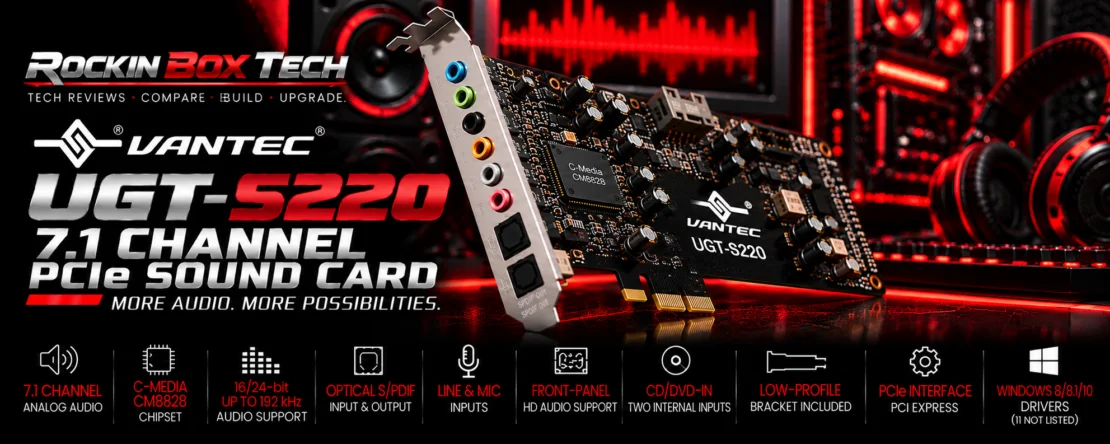
Vantec UGT-S220 7.1 Channel PCIe Sound Card Review
A practical internal PCIe sound card offering 7.1-channel analog audio, 24-bit / 192 kHz format support, two-way optical S/PDIF, front-panel audio and low-profile installation capability.
What It Is
The Vantec UGT-S220 is an internal PCI Express sound card designed to add multichannel analog and digital audio connectivity to a desktop PC.
Built around the C-Media CM8828 chipset, it supports up to 7.1-channel analog output and 16-bit or 24-bit audio formats at sample rates reaching 192 kHz. It also provides optical S/PDIF input and output, allowing digital audio to travel in either direction between the PC and compatible equipment.
This is primarily a connectivity-focused sound card rather than a premium DAC or high-powered headphone solution. Its strongest features are multichannel output, digital I/O, compact dimensions and support for low-profile systems.
Key Specifications
| Model | Vantec UGT-S220 |
|---|---|
| Interface | PCI Express |
| PCIe Compatibility | PCI Express 1.1 interface compatible |
| Chipset | C-Media CM8828 |
| Audio Channels | Up to 7.1-channel analog output |
| Audio Resolution | 16-bit / 24-bit |
| Supported Sample Rates | 44.1 / 48 / 88.2 / 96 / 176.4 / 192 kHz |
| Analog Input | 1 × Line In |
| Microphone Input | 1 × Mic In |
| Speaker Outputs | Front, side, rear and center/bass |
| Digital Input | Optical S/PDIF input |
| Digital Output | Optical S/PDIF output |
| Front-Panel Audio | Intel HD Audio compatible |
| Dimensions | 69 × 87 × 19 mm |
| Low-Profile Bracket | Included |
| Official Windows Support | Windows 8, 8.1 and 10 among supported versions |
| Official Windows 11 Support | Not currently listed by Vantec |
C-Media CM8828 Audio Controller
The UGT-S220 uses the C-Media CM8828 chipset with an integrated HD Audio controller.
PCIe Audio
The CM8828 provides the core audio functionality for the card's PCI Express interface and multichannel output.
7.1 Channels
The controller supports the multiple analog outputs required for a traditional eight-channel speaker configuration.
Digital I/O
Integrated S/PDIF transmitter and receiver functionality supports the card's optical input and output.
7.1-Channel Analog Audio
The UGT-S220 provides analog connections for front, rear, side and center/subwoofer channels, allowing a compatible PC to drive up to a 7.1-channel analog speaker configuration.
Traditional Surround Systems
Existing analog PC speaker systems can connect directly to the card without requiring HDMI or an external USB audio device.
Flexible Channel Modes
The analog outputs can be configured for simpler stereo and multichannel layouts as well as the full eight-channel setup.
24-bit / 192 kHz Audio Support
Vantec specifies 16-bit and 24-bit audio support at sample rates ranging from 44.1 kHz through 192 kHz.
24-bit Audio
The card supports 24-bit formats rather than being restricted to basic 16-bit desktop playback.
Up to 192 kHz
Supported sample rates extend through 192 kHz for compatible audio sources and software.
Multiple Sample Rates
Vantec lists 44.1, 48, 88.2, 96, 176.4 and 192 kHz among the card's supported audio formats.
Optical S/PDIF Input & Output
One of the UGT-S220's strongest connectivity features is its integrated optical S/PDIF transmitter and receiver.
Optical Input
A compatible external digital source can send S/PDIF audio into the computer through the optical input.
Optical Output
The computer can send digital audio to compatible receivers, DACs, speaker systems and other optical equipment.
Line & Microphone Inputs
In addition to its speaker outputs, the UGT-S220 includes separate analog line and microphone inputs.
Line In
Vantec identifies the line input for compatible tape, CD, DVD and other external audio sources used for playback mixing or recording.
Microphone In
A dedicated microphone input supports compatible analog microphones for communication and basic recording.
Intel HD Front-Panel Audio
The card includes an Intel HD Audio-compatible front-panel header.
Vantec's documentation specifies headphone jack detection and automatic switching of audio output from the rear panel to the front panel when a compatible front headphone connection is used.
Low-Profile Installation
At approximately 69 × 87 × 19 mm, the UGT-S220 is physically compact and Vantec includes a low-profile mounting bracket.
Standard Desktops
The card can be used in conventional desktop PCs with a suitable PCIe expansion slot.
Slim Systems
The included low-profile bracket expands installation options to compatible small-form-factor desktops.
Vantec also supplies a Mini-DIN-to-3.5 mm fan-out cable as part of the package.
Windows Compatibility
The UGT-S220 meets the minimum operating-system requirement for this Rockin Box Tech category, but it does not receive the same modern-Windows rating as cards with explicitly documented Windows 11 support.
Windows 10
Vantec officially lists Windows 10 support for the UGT-S220.
Windows 8 / 8.1
Windows 8 and Windows 8.1 are also explicitly included in the manufacturer's system requirements.
Windows 11
Windows 11 is not currently listed for the UGT-S220 by Vantec. Rockin Box Tech therefore does not claim official Windows 11 support.
What Owners Are Saying
Available owner and retailer feedback on the UGT-S220 is mixed, and the current exact-model review pool is relatively small.
Useful Surround Upgrade
Positive reports include users successfully bypassing limited motherboard audio and gaining multichannel surround output.
Installation Can Be Straightforward
Some owners describe installation as relatively easy once the card and correct audio device are properly configured.
Configuration & Stability Complaints
Other reports describe driver installation difficulties, audio settings that required manual adjustment, noise, format-switching behavior or system instability.
Where the UGT-S220 Makes Sense
Windows 10 PCs
The cleanest current compatibility case is a Windows 10 desktop using Vantec's supported driver environment.
7.1 Analog Speakers
Existing multichannel analog PC speakers can connect directly to the card's dedicated outputs.
Optical Equipment
Two-way optical S/PDIF is valuable when a PC needs both to receive and transmit digital audio.
Compact PCs
The small PCB and included low-profile bracket make the card suitable for compatible slim desktop systems.
Additional Audio Inputs
Separate line, microphone and optical inputs provide more connectivity than a simple playback-only expansion card.
Budget-Oriented Expansion
The UGT-S220 is better viewed as a practical audio expansion product than as a premium audiophile or high-powered headphone solution.
Strengths & Limitations
Strengths
- True internal PCI Express sound card
- Official Windows 8, 8.1 and Windows 10 support
- C-Media CM8828 chipset
- Up to 7.1-channel analog output
- 16-bit and 24-bit audio support
- Sample rates up to 192 kHz
- Optical S/PDIF input
- Optical S/PDIF output
- Dedicated line input
- Dedicated microphone input
- Intel HD front-panel audio support
- Front headphone jack detection
- Compact 69 × 87 × 19 mm design
- Low-profile bracket included
- Mini-DIN fan-out cable included
- Adds another manufacturer to the review lineup
Limitations
- No official Windows 11 support currently listed by Vantec
- No dedicated premium DAC specification highlighted by Vantec
- No high-impedance headphone amplifier specification
- No external desktop control module
- Requires an available PCIe slot
- Owner feedback includes driver and configuration complaints
- Some anecdotal reports mention noise or stability issues
- Current exact-model consumer feedback is limited
- S/PDIF has bandwidth and format limitations
- Modern motherboard audio may already satisfy many users
Works Best With
Windows 10 Desktops
Windows 10 provides the strongest modern compatibility case explicitly documented by Vantec.
Analog Surround Systems
The card is useful for PCs connected to existing 5.1 or 7.1-channel analog speaker systems.
Optical Audio Hardware
Users needing both optical input and output receive one of the UGT-S220's most useful connectivity features.
Rockin Box Tech Summary
The Vantec UGT-S220 broadens this internal sound-card lineup with a fifth manufacturer and another practical alternative to the more gaming-oriented Creative and ASUS products.
Its strongest feature is connectivity. The card provides up to 7.1-channel analog output, optical S/PDIF input and output, separate line and microphone inputs, and Intel HD front-panel audio support.
The C-Media CM8828 platform supports 16-bit and 24-bit audio at sample rates reaching 192 kHz. The compact PCB and included low-profile bracket also make the card adaptable to systems where expansion space is limited.
This should not be positioned as a premium audiophile card. Vantec does not advertise a high-end dedicated DAC architecture or powerful headphone amplifier comparable with the more expensive cards earlier in this series.
Owner feedback also deserves caution. Some users report a straightforward upgrade and useful surround capability, while others describe configuration, driver, noise or stability problems. The available samples are too limited to treat either experience as universal.
Operating-system support is the largest qualification. Vantec explicitly supports Windows 8, 8.1 and Windows 10, so the card passes the minimum rule established for this category. However, Vantec does not currently list Windows 11 support for the UGT-S220.
For a compatible Windows PC that specifically needs inexpensive 7.1 analog expansion, optical input and output or low-profile installation, the UGT-S220 remains a useful specialist option. For a brand-new Windows 11 build, a card with explicit manufacturer Windows 11 support provides a cleaner compatibility path.
Research Disclosure: Rockin Box Tech reviews are research-driven. Technical information is compiled from current manufacturer specifications, manuals, driver/support information and available consumer feedback. Rockin Box Tech does not represent that this product was physically tested unless explicitly stated. Manufacturer specifications are treated as technical claims, while owner reports are treated as anecdotal consumer experience rather than controlled testing. Driver support, operating-system compatibility, pricing and product availability may change over time.