
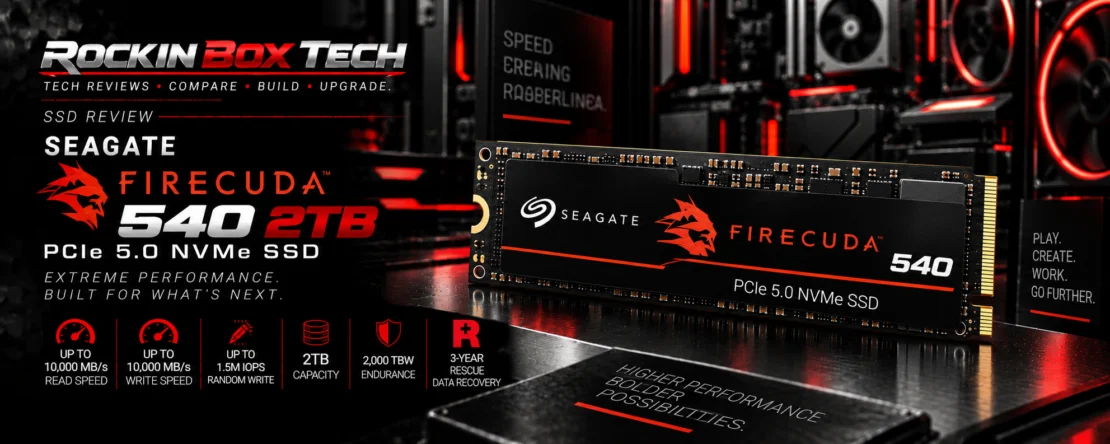
Seagate FireCuda 540 2TB NVMe SSD Review
What Is the Seagate FireCuda 540?
Early High-End Gen5 SSD
The FireCuda 540 was one of Seagate's first consumer PCIe 5.0 NVMe SSDs, targeting enthusiast desktops, gaming systems and demanding creator workloads.
Performance Plus Endurance
Rather than focusing only on peak benchmark speed, Seagate gives the 2TB model a particularly strong 2,000 TBW endurance rating.
2TB Review Model
This review focuses specifically on the 2TB standard model ZP2000GM30004. The 1TB version has different performance and endurance specifications.
Verified 2TB Specifications
| Product | Seagate FireCuda 540 |
| Model | ZP2000GM30004 |
| Capacity Reviewed | 2TB |
| Form Factor | M.2 2280-D2 |
| Interface | PCIe Gen5 ×4 |
| Protocol | NVMe 2.0 |
| NAND | 3D TLC |
| Controller Platform | Phison E26 |
| DRAM | Dedicated LPDDR4 |
| Sequential Read | Up to 10,000 MB/s |
| Sequential Write | Up to 10,000 MB/s |
| Random Read | Up to 1,490,000 IOPS |
| Random Write | Up to 1,500,000 IOPS |
| Endurance | 2,000 TBW |
| MTBF | 1.8 million hours |
| Average Active Power | 11W |
| PS3 Idle Power | 144mW average |
| Operating Temperature | 0°C to 70°C internal |
| Security | TCG Opal 2.01 SED support |
| Warranty | 5-year limited warranty |
| Data Recovery | 3-year Rescue Data Recovery Services |
PCIe 5.0 Performance
10 GB/s Read
Seagate rates the 2TB FireCuda 540 for sequential reads up to 10,000 MB/s, substantially above the bandwidth available from PCIe 4.0 ×4.
10 GB/s Write
Sequential writes are also rated up to 10,000 MB/s, giving the 2TB model balanced peak read and write specifications.
Strong Random Performance
Random performance reaches up to 1.49 million read IOPS and 1.5 million write IOPS under Seagate's specified test conditions.
2,000 TBW Endurance
A Major FireCuda Strength
The 2TB FireCuda 540 carries a 2,000 TBW endurance rating. That is a particularly strong specification for a consumer-oriented 2TB NVMe SSD and is one of the drive's clearest differentiators.
Capacity-Specific Rating
Seagate rates the 1TB model for 1,000 TBW and the 2TB model for 2,000 TBW, maintaining approximately 1,000 TBW of rated writes per terabyte of capacity.
Rescue Data Recovery Services
Three Years of Rescue Coverage
The FireCuda 540 includes three years of Seagate Rescue Data Recovery Services in addition to its standard limited warranty.
Useful Additional Protection
Data recovery is never guaranteed, and Rescue coverage is not a substitute for a proper backup strategy. It does, however, provide an additional recovery option if a covered drive failure occurs.
Independent 2TB Testing
Strong Gaming Results
Tom's Hardware tested the exact 2TB capacity and found strong results in its gaming-oriented 3DMark storage workload, placing the drive among the faster early PCIe 5.0 SSDs tested at the time.
Fast File Transfers
Independent testing also showed a substantial improvement in file-copy performance over the previous FireCuda 530 generation.
Workstation-Oriented Character
Its sustained performance, endurance and support features make the drive relevant beyond gaming, particularly for high-end desktop and creator use.
Sustained Write Performance
Approximately 220GB pSLC Cache
Tom's Hardware measured roughly a 220GB high-speed pseudo-SLC cache on its 2TB sample, with the drive writing at approximately 10 GB/s while operating inside that cache.
Approximately 3.5 GB/s TLC
After the cache was exhausted, the same independent testing measured steady-state TLC write performance around 3.5 GB/s.
Cooling and Thermals
A Heatsink Is Important
Seagate's product manual states that the standard models require a heatsink for optimal performance. This is especially important during prolonged high-bandwidth workloads.
Throttling Without Cooling
Tom's Hardware observed thermal throttling when testing the drive without a heatsink. With active cooling directed at the SSD, its test sample remained at or below approximately 58°C.
Power Consumption
Early Gen5 Tradeoff
The FireCuda 540 uses the first-wave Phison E26 platform, which delivers high performance but is less power-efficient than newer generations of PCIe 5.0 SSD controllers.
11W Average Active Rating
Seagate specifies average active power at 11W for the 2TB model and average PS3 idle power at 144mW.
Gaming and DirectStorage
Gaming-Focused FireCuda Platform
Seagate designed the FireCuda 540 for enthusiast gaming and future storage-heavy game workloads, including scenarios involving sustained random reads.
Gen5 Is Still Workload Dependent
A 10 GB/s SSD does not make every game load proportionally faster than a strong Gen4 SSD. CPU processing, decompression and game-engine behavior remain important parts of real-world loading performance.
PCIe Compatibility
Gen5 ×4 for Full Performance
Maximum throughput requires a PCIe 5.0 ×4-capable M.2 connection. Older compatible PCIe interfaces restrict the available bandwidth.
Check Motherboard Lane Sharing
Some motherboards share PCIe resources between Gen5 M.2 sockets, graphics slots and other devices. Check the motherboard manual before choosing the installation slot.
Owner and Community Perspective
Reasons Enthusiasts Consider It
- Strong PCIe 5.0 performance
- 3D TLC NAND and dedicated DRAM
- Exceptional 2,000 TBW endurance rating
- Five-year limited warranty
- Three-year Rescue Data Recovery Services
- Strong sustained-write performance
Common Considerations
- Newer Gen5 SSDs can deliver substantially higher peak throughput
- The E26 platform is relatively power hungry
- Effective M.2 cooling is important
- Many everyday workloads cannot exploit full Gen5 bandwidth
Strengths and Limitations
Strengths
- Up to 10,000 MB/s sequential read and write
- PCIe 5.0 ×4 and NVMe 2.0
- 3D TLC NAND
- Dedicated DRAM
- Exceptional 2,000 TBW endurance on the 2TB model
- Strong sustained TLC write performance
- Five-year limited warranty
- Three-year Rescue Data Recovery Services
Limitations
- Peak speeds are below newer 14+ GB/s Gen5 flagships
- Relatively high power consumption
- Effective heatsink cooling is important
- Full performance requires PCIe 5.0 ×4 support
- Everyday gaming may show limited gains over strong Gen4 SSDs
Works Best With
High-End Gaming PCs
PCIe 5.0 systems with effective M.2 cooling and users who value FireCuda's gaming-focused platform and support features.
Creator Workstations
Large-file transfers, content creation and scratch workloads capable of exploiting sustained local-storage performance.
Heavy-Write Users
Systems where the unusually strong 2,000 TBW endurance rating is more important than owning the newest peak-speed Gen5 platform.
Rockin Box Tech Summary
The Seagate FireCuda 540 2TB is no longer defined by having the highest PCIe 5.0 headline speed. Newer flagship SSDs have moved well beyond its 10,000 MB/s sequential rating.
What keeps the FireCuda 540 interesting is the rest of the package: 3D TLC NAND, dedicated DRAM, strong sustained-write behavior, a substantial 2,000 TBW endurance rating, a five-year limited warranty and three years of Seagate Rescue Data Recovery Services.
Its main tradeoffs are the relatively high power and cooling demands of the early Phison E26 platform. For a properly cooled PCIe 5.0 desktop or workstation where endurance and support matter as much as peak benchmark numbers, the FireCuda 540 2TB remains a distinctive high-performance SSD.