
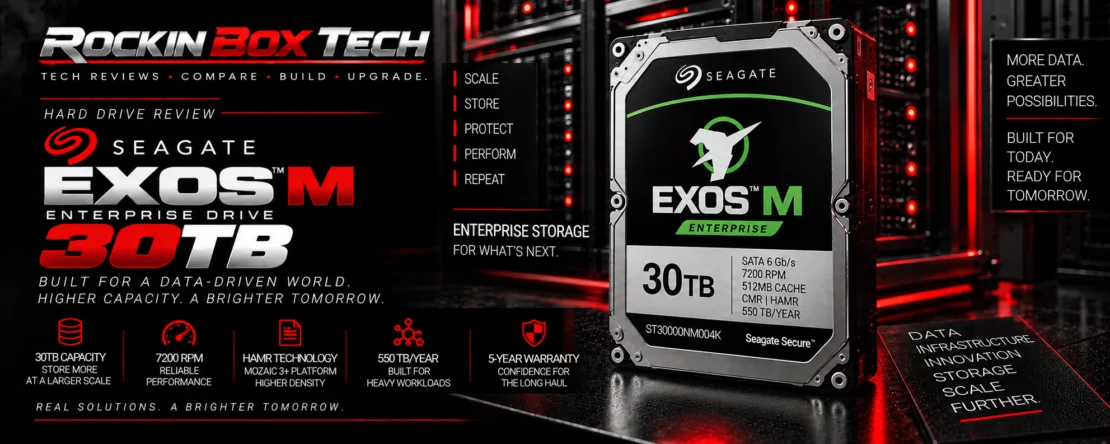
Seagate Exos M 30TB
Ultra-high-capacity enterprise storage built on Seagate's Mozaic 3+ HAMR platform for data centers, storage servers and massive-scale infrastructure.
Overview
The Seagate Exos M 30TB ST30000NM004K represents a major step forward in mechanical storage density. Rather than targeting ordinary desktop PCs or conventional home NAS systems, Exos M is designed for enterprise data centers and large-scale storage infrastructure where capacity per drive bay is critical.
The ST30000NM004K provides 30TB of capacity in a conventional 3.5-inch enterprise hard-drive form factor. It combines a SATA 6 Gb/s interface, 7200 RPM operation, 512MB multisegmented cache and helium-sealed construction.
The defining technology is Seagate's Mozaic 3+ platform using Heat-Assisted Magnetic Recording, or HAMR. HAMR enables substantially higher areal density while allowing the drive to retain conventional magnetic recording behavior from the host system's perspective.
Core Specifications
| Model | ST30000NM004K |
| Product Family | Seagate Exos M |
| Capacity | 30TB |
| Form Factor | 3.5-inch |
| Interface | SATA 6 Gb/s |
| Sector Format | 512e |
| Recording Technology | CMR using Seagate Mozaic 3+ HAMR platform |
| Drive Construction | Helium sealed |
| Spindle Speed | 7200 RPM |
| Cache | 512MB multisegmented |
| Maximum Sustained Transfer Rate | Up to 275 MB/s |
| Workload Rate Limit | 550 TB/year |
| MTBF | 2.5 million hours |
| Load / Unload Cycles | 600,000 |
| Hot-Plug Support | Yes |
| Power Management | PowerChoice and PowerBalance |
| Limited Warranty | 5 years |
Mozaic 3+ & HAMR
The most important technological difference between Exos M and conventional high-capacity HDDs is Seagate's Mozaic platform and Heat-Assisted Magnetic Recording technology.
As hard-drive tracks become increasingly dense, maintaining stable magnetic bits becomes more difficult. HAMR addresses this by briefly heating an extremely small area of the disk surface while data is being written, allowing information to be recorded at higher density.
The process occurs entirely inside the drive. From the server or operating system's perspective, Exos M continues to behave as a conventional block-storage hard drive.
Enterprise Storage Focus
Massive Capacity
Thirty terabytes per drive allows data centers to increase total storage capacity without increasing drive-bay count at the same rate.
24×7 Infrastructure
Exos M is engineered for enterprise systems where storage remains active continuously under sustained multi-user workloads.
550 TB/Year
The enterprise workload rating supports substantially heavier annual data movement than ordinary consumer desktop storage.
Why 30TB Matters
Capacity per drive bay has major implications in enterprise storage. Increasing individual drive capacity allows more data to be stored inside an existing rack, enclosure or data-center footprint.
Fewer drives may be required to reach a particular capacity target, potentially reducing the number of drive bays, chassis, controllers, cables and other infrastructure required for a storage deployment.
At large scale, storage density can affect rack utilization, power consumption, cooling requirements and overall infrastructure complexity.
Performance Profile
Up to 275 MB/s
Seagate specifies maximum sustained transfer performance of up to 275 MB/s for the ST30000NM004K.
7200 RPM
Enterprise-class 7200 RPM operation provides the sustained mechanical performance expected from large-scale storage drives.
512MB Cache
A 512MB multisegmented cache assists with buffering and command handling during sustained storage workloads.
CMR Enterprise Storage
Seagate specifies the 30TB Exos M as a CMR drive. Conventional Magnetic Recording keeps adjacent tracks independently writable, providing predictable behavior during sustained writes and large-scale storage operations.
That distinction is important in enterprise arrays, where rebuilds, replication, backups and large sequential write workloads can place sustained pressure on every drive.
Exos M combines CMR track organization with HAMR recording technology to increase storage density without using drive-managed shingled recording.
Helium-Sealed Design
Exos M uses a helium-sealed enclosure. Helium has lower density than ordinary air, reducing aerodynamic resistance around rapidly rotating platters.
This helps manufacturers operate multiple platters inside a standard 3.5-inch drive while managing vibration, power consumption and thermal characteristics.
The 30TB model uses ten disks and twenty heads, demonstrating how much magnetic media Seagate has integrated into the conventional enterprise HDD form factor.
PowerChoice & PowerBalance
PowerChoice
Seagate's PowerChoice technology provides idle-power management intended to reduce energy consumption when the drive is not actively handling full workloads.
PowerBalance
PowerBalance technology allows enterprise deployments to manage the balance between drive performance and power consumption according to infrastructure requirements.
Reliability & Workload Rating
Seagate specifies a 2.5-million-hour MTBF and a 550 TB/year workload rate limit for the Exos M 30TB.
These figures reflect the drive's intended enterprise environment, where storage devices can operate continuously and process far more annual data than typical desktop hard drives.
MTBF is a statistical reliability measure across a drive population. It does not mean an individual drive is expected to physically run for 2.5 million hours.
The ST30000NM004K is backed by Seagate's five-year limited warranty.
Enterprise Data Integrity
Exos M includes enterprise-oriented features such as SuperParity, firmware verification and hot-plug support.
These features are designed around managed storage infrastructure where drives may be replaced, monitored and serviced as components within much larger storage systems.
The drive should therefore be evaluated as part of an enterprise storage architecture rather than as an isolated desktop component.
Exos M vs NAS Drives
Exos M
Designed primarily for enterprise data centers, storage servers, cloud infrastructure and extremely dense large-scale storage deployments.
NAS HDD
Drives such as IronWolf Pro are optimized around NAS appliances, multi-bay compatibility and features aimed more directly at NAS users and administrators.
Best Uses
Data Centers
The primary environment for Exos M, where storage density, reliability and infrastructure efficiency are critical.
Enterprise Storage Servers
Well suited to high-capacity servers handling backups, archives, object storage and large datasets.
Massive Data Archives
Thirty terabytes per drive makes Exos M attractive for large media libraries, research data, AI datasets and long-term digital archives.
HDD vs SSD at Enterprise Scale
Enterprise SSDs provide dramatically higher IOPS and lower access latency, making them better suited to workloads requiring rapid random access.
High-capacity HDDs address a different requirement: storing enormous quantities of data while maximizing capacity per drive bay.
Modern data centers frequently use both technologies, with SSDs handling performance-sensitive data and high-capacity HDDs forming large capacity tiers for bulk storage.
Noise, Heat & Deployment
Exos M is an enterprise mechanical hard drive rather than an acoustically optimized consumer product. Seek activity and rotational noise should be expected.
Enterprise chassis are normally designed around forced airflow and multiple continuously operating drives, so thermal management is an infrastructure consideration rather than an optional extra.
Buyers considering Exos M for a workstation, home server or NAS should confirm physical compatibility, cooling and acceptable acoustic levels before deployment.
Owner & Community Perspective
Exos drives are commonly considered by storage enthusiasts and server builders who want enterprise-class workload specifications and very high capacity, even outside traditional data centers.
The major attraction of this 30TB model is straightforward: exceptional storage density in a familiar 3.5-inch SATA form factor. Its HAMR-based Mozaic platform also makes it technologically significant within the current HDD market.
Typical considerations surrounding enterprise HDDs include higher acoustic output, vibration, power requirements and the importance of buying through reputable channels with clearly defined warranty coverage.
Strengths & Limitations
Strengths
- Exceptional 30TB capacity
- Mozaic 3+ HAMR technology
- CMR recording architecture
- Helium-sealed enterprise design
- 7200 RPM operation
- 512MB multisegmented cache
- Up to 275 MB/s sustained transfer rate
- 550 TB/year workload rating
- 2.5-million-hour MTBF specification
- PowerChoice and PowerBalance technologies
- Hot-plug support
- Five-year limited warranty
Limitations
- Mechanical access latency remains far behind SSDs
- Enterprise acoustics may be noticeable in quiet rooms
- High-density HDD deployments require proper cooling
- 30TB creates very long rebuild and backup operations
- Large capacity increases the impact of inadequate backups
- Enterprise features may be unnecessary for ordinary desktops
- Exact interface and security variants must be verified
Works Best With
Enterprise Servers
Designed for systems built around continuous operation, monitoring and high annual storage workloads.
Large Storage Arrays
Thirty terabytes per drive can dramatically increase total array capacity without increasing drive count at the same rate.
Layered Backup
Massive storage capacity should always be protected by redundancy and independent backup copies appropriate to the importance of the data.
Rockin Box Tech Summary
The Seagate Exos M 30TB ST30000NM004K is one of the most technologically significant hard drives in this review lineup. Its purpose is not simply to provide another few terabytes of conventional storage, but to increase mechanical storage density through Seagate's Mozaic 3+ HAMR platform.
Thirty terabytes in a standard 3.5-inch drive allows enterprise systems to place substantially more data into existing storage infrastructure. CMR recording, 7200 RPM operation, 512MB cache and up to 275 MB/s sustained transfer performance provide the underlying mechanical-storage capability.
The 550 TB/year workload rating, 2.5-million-hour MTBF, helium-sealed construction, PowerChoice, PowerBalance and five-year warranty reinforce its enterprise role.
Exos M does not replace SSDs where extremely low latency and high random I/O are required. Its strength is different: delivering enormous storage capacity per drive bay for data centers, archives, storage servers and other environments where data continues to grow at massive scale.