
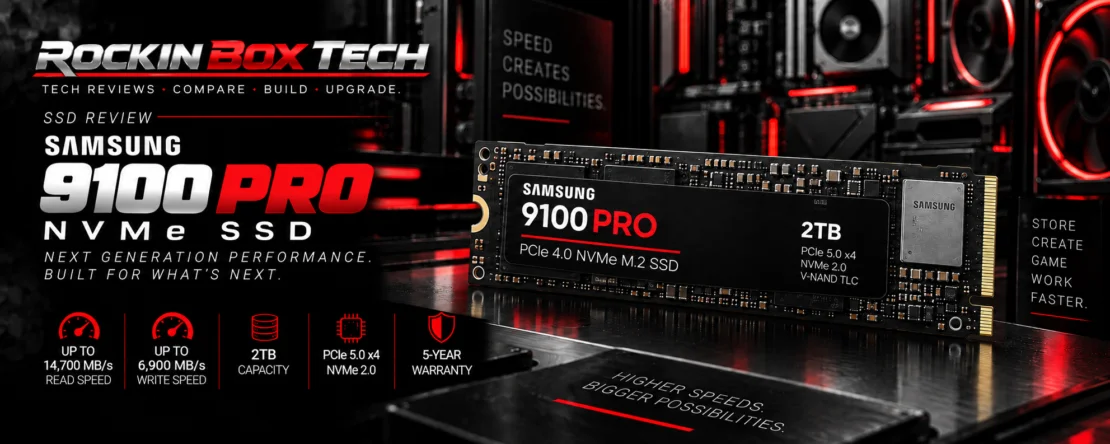
Samsung 9100 PRO 2TB NVMe SSD Review
What Is the Samsung 9100 PRO?
Flagship Gen5 Storage
The 9100 PRO is Samsung's high-performance PCIe 5.0 NVMe SSD family, designed for modern client PCs and other compatible high-bandwidth systems.
Samsung Hardware Platform
Samsung combines an in-house controller with Samsung TLC V-NAND and dedicated LPDDR4X cache memory rather than relying on a DRAM-less design.
2TB Review Model
This review focuses specifically on the 2TB non-heatsink model. Performance, DRAM capacity, endurance and other specifications can differ across the 1TB, 2TB, 4TB and 8TB versions.
Verified 2TB Specifications
| Product | Samsung 9100 PRO |
| Capacity Reviewed | 2TB |
| Model Code | MZ-VAP2T0B |
| Form Factor | M.2 2280 |
| Interface | PCIe 5.0 ×4, NVMe 2.0 |
| NAND | Samsung V-NAND TLC |
| Controller | Samsung in-house controller |
| DRAM Cache | 2GB LPDDR4X |
| Sequential Read | Up to 14,700 MB/s |
| Sequential Write | Up to 13,400 MB/s |
| Random Read | Up to 1,850K IOPS |
| Random Write | Up to 2,600K IOPS |
| Endurance | 1,200 TBW |
| Encryption | AES-256, TCG/Opal 2.0 and Microsoft eDrive support |
| Dimensions | Maximum 80.15 × 22.15 × 2.38 mm |
| Weight | Maximum 9.0 g |
| Warranty | 5-year limited warranty or TBW limit, whichever occurs first |
PCIe 5.0 Performance
Up to 14.7 GB/s Read
The 2TB 9100 PRO is rated for sequential reads up to 14,700 MB/s, putting it firmly in flagship PCIe 5.0 territory.
Up to 13.4 GB/s Write
Sequential writes are rated up to 13,400 MB/s when Samsung's Intelligent TurboWrite technology is operating within its supported conditions.
High Random Performance
Samsung rates the 2TB version for up to 1.85 million random-read IOPS and 2.6 million random-write IOPS under its specified test conditions.
Where Gen5 Speed Actually Helps
Large File Transfers
High sequential throughput can substantially benefit workflows involving very large local files when the source and destination are fast enough to keep the SSD supplied with data.
Content Creation
High-resolution video, large project files, scratch-disk workloads and other storage-intensive professional tasks are better positioned to use Gen5 bandwidth than ordinary desktop activity.
High-End Workstations
Systems built around current PCIe 5.0 platforms can take advantage of the drive without immediately restricting it to older-generation interface speeds.
Gaming and Everyday PC Use
Excellent, But Gen5 Is Not Magic
The 9100 PRO is a very fast gaming SSD, but game loading and ordinary desktop responsiveness do not scale directly with headline sequential bandwidth. A strong PCIe 4.0 SSD can still feel very similar in many everyday workloads.
Storage Performance Depends on the Workload
PCIe 5.0 becomes more meaningful when applications can actually generate sustained storage traffic. Buyers upgrading primarily for Windows startup, web browsing or basic application launches should keep expectations realistic.
TLC V-NAND, DRAM and TurboWrite
TLC NAND
Samsung uses TLC V-NAND rather than positioning the 9100 PRO as a lower-cost QLC-based flagship.
Dedicated DRAM
The 2TB model includes 2GB of LPDDR4X cache memory, supporting the controller's mapping and management operations.
Intelligent TurboWrite
Samsung uses a high-speed write cache to reach peak write performance. Sustained transfers beyond the effective cache can behave differently from short benchmark bursts.
Cooling and Power
Cooling Matters
Flagship PCIe 5.0 SSDs operate at a performance level where thermal management should be part of the build plan. A motherboard M.2 heatsink or Samsung's heatsink-equipped version is preferable for sustained high-load use.
Independent Thermal Testing
Independent testing by Tom's Hardware recorded a maximum temperature around 67°C under its test conditions, with the drive spending much of the workload below 60°C. The publication still recommends appropriate cooling for desktop use.
Endurance and Warranty
1,200 TBW
Samsung rates the 2TB 9100 PRO for 1,200 terabytes written, providing substantial write endurance for a consumer/prosumer client SSD.
5-Year Limited Warranty
Coverage is limited to five years or the rated TBW threshold, whichever occurs first, subject to Samsung's warranty terms.
Encryption Support
The platform supports AES-256 encryption along with TCG/Opal 2.0 and Microsoft eDrive functionality.
PCIe 5.0 Compatibility
For Full Performance
The SSD requires a PCIe 5.0 ×4-capable M.2 connection to reach its intended maximum bandwidth. Motherboard lane sharing and slot configuration should be checked before installation.
Older PCIe Systems
NVMe compatibility can allow operation on older PCIe generations, but available interface bandwidth will restrict performance. Buying a flagship Gen5 SSD for a permanently Gen4-limited system reduces much of the reason for choosing this class of drive.
Independent Testing Perspective
Independent testing confirms that the 9100 PRO is a genuinely high-performance SSD, but benchmark leadership varies by workload. Tom's Hardware found strong overall performance and comparatively solid efficiency for a high-end Gen5 drive, while also finding competing PCIe 5.0 models faster in some tests.
That distinction matters: the 9100 PRO should be evaluated as a complete storage platform rather than solely by its peak sequential specifications.
Owner and Community Perspective
Commonly Appreciated
- Very high PCIe 5.0 transfer capability
- Samsung's integrated controller, NAND and management ecosystem
- TLC NAND and dedicated DRAM
- Strong endurance rating
- Heatsink and non-heatsink configurations
Common Considerations
- Many everyday workloads cannot exploit full Gen5 bandwidth
- Proper M.2 cooling remains important
- Platform compatibility should be checked carefully
- High-end Gen4 SSDs remain capable alternatives for less demanding systems
Strengths and Limitations
Strengths
- Extremely high PCIe 5.0 sequential performance
- Samsung TLC V-NAND
- Dedicated 2GB LPDDR4X DRAM on the 2TB model
- Strong 1,200 TBW endurance rating
- High random-write capability
- Five-year limited warranty
- Available with or without Samsung heatsink
Limitations
- Full performance requires a suitable PCIe 5.0 platform
- Real applications rarely sustain headline benchmark speeds continuously
- Gen5 advantage can be small in ordinary desktop tasks
- High-performance operation benefits from dedicated cooling
- 2TB performance specifications should not be confused with faster 4TB/8TB figures
Works Best With
High-End PCIe 5.0 PCs
Modern systems with a true PCIe 5.0 ×4 M.2 slot and adequate SSD cooling.
Creator Workstations
Large media projects, scratch storage, high-resolution content and other workflows capable of generating heavy local storage traffic.
Performance Enthusiasts
Builders specifically seeking flagship-class NVMe performance rather than simply replacing a slower boot drive.
Rockin Box Tech Summary
The Samsung 9100 PRO 2TB represents Samsung's move into the upper tier of PCIe 5.0 consumer storage. Its combination of an in-house controller, TLC V-NAND, 2GB of dedicated DRAM, up to 14,700 MB/s sequential reads and 13,400 MB/s writes gives high-end desktops and workstations enormous storage bandwidth.
The important question is not whether the drive is fast—it clearly is—but whether the intended workload can use that speed. Content creation, sustained large-file work and high-performance workstation tasks provide a stronger reason to choose this class of SSD than ordinary web browsing, application launching or routine gaming.
For a properly equipped PCIe 5.0 system with good M.2 cooling, the 9100 PRO 2TB is a serious flagship storage option. For systems limited to PCIe 4.0 or workloads that rarely stress storage, a less extreme SSD may deliver much of the same everyday responsiveness.