
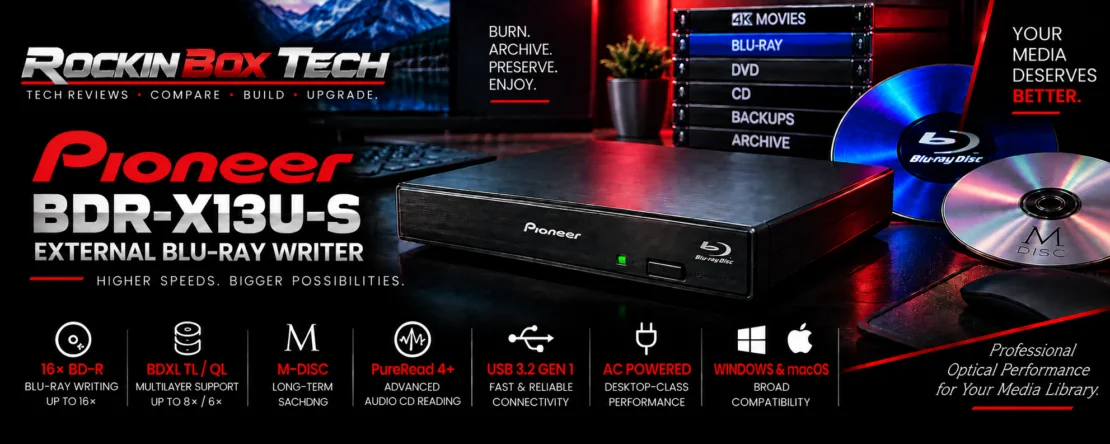
Pioneer BDR-X13U-S External Blu-ray Writer Review
A full-size desktop optical writer built around high-speed Blu-ray, DVD and CD recording, BDXL, M-DISC and Pioneer's PureRead 4+ technology.
What It Is
The Pioneer BDR-X13U-S is a full-size external Blu-ray, DVD and CD writer designed for users who prioritize optical-disc performance over portability.
It uses a conventional tray-loading desktop mechanism and a dedicated AC power supply rather than relying on USB bus power. That makes it substantially larger than portable models such as the Pioneer BDR-XD08B or ASUS SBW-06D5H-U, but it also allows considerably higher recording speeds.
Its feature set includes up to 16× single-layer BD-R writing, multilayer BDXL support, M-DISC compatibility and Pioneer's PureRead 4+ technology for audio-CD reading.
Key Specifications
| Model | Pioneer BDR-X13U-S |
|---|---|
| Drive Type | External desktop Blu-ray / DVD / CD reader and writer |
| Loading Mechanism | Tray loading |
| Interface | USB 3.2 Gen 1 |
| Maximum BD-R SL Write | 16× |
| Maximum BD-R DL Write | 14× |
| Maximum BD-R TL Write | 8× |
| Maximum BD-R QL Write | 6× |
| BD-RE Write | Up to 2× |
| Maximum BD-ROM Read | 12× single-layer / 8× dual-layer |
| BD-R XL Read | Up to 6× for TL / QL media |
| Maximum DVD±R Write | 16× |
| Maximum CD-R Write | 48× |
| CD-RW Write | Up to 24× |
| M-DISC | Supported on compatible Blu-ray and DVD media |
| Audio CD Technology | PureRead 4+ |
| Orientation | Horizontal or vertical |
| Power | External AC adapter |
| Operating Systems | Windows 8.1 or later / macOS 10.11 or later |
Why 16× Blu-ray Writing Matters
16× BD-R
Single-layer BD-R recording reaches a substantially higher maximum speed than the 6× portable writers already examined in this category.
14× Dual Layer
Dual-layer BD-R recording remains fast at up to 14× instead of dropping immediately into typical slim-drive territory.
Multilayer Support
Triple-layer and quad-layer BD-R media remain supported, providing high-capacity optical options when compatible media is available.
PureRead 4+
PureRead 4+ is one of the features that distinguishes the BDR-X13U-S from generic desktop optical writers. Pioneer developed PureRead around improving audio-CD reading behavior when the drive encounters difficult disc conditions.
Audio CD Focus
PureRead is particularly relevant to consumers extracting audio from personally owned CD collections.
Reading Difficult Discs
The technology adjusts drive behavior when dealing with problematic audio-CD sectors rather than treating raw speed as the only priority.
Archive Work
For users preserving older music collections, consistent disc reading can be more important than reaching maximum rotational speed.
What Owners Are Saying
Exact-model owner evidence for the BDR-X13U-S is limited. B&H currently shows only four owner reviews for this specific model, which is too small a sample for broad conclusions about long-term reliability.
The available evidence is still useful when combined carefully with enthusiast reports from people using Pioneer desktop optical drives for substantial personal disc collections.
Serious Disc Work
The model appears in enthusiast discussions involving repeated Blu-ray reading and personal media-library workflows rather than occasional DVD-only use.
Full-Size Mechanism
Buyers interested in this model generally prioritize a substantial desktop drive and high optical speeds over the convenience of an ultra-slim portable enclosure.
Availability Is Now a Concern
Current purchasing decisions are complicated by shrinking availability. A drive can have strong specifications while still becoming a poor choice if only questionable or heavily used examples remain for sale.
What Enthusiast Use Shows
The BDR-X13U-S has developed visibility in optical-media enthusiast communities, including users maintaining large personal disc libraries. That gives us useful information about how the drive is actually being used outside specification sheets.
Large Personal Libraries
Community reports include BDR-X13U-S units used repeatedly across large numbers of discs, showing that buyers often choose this class of drive for more than occasional optical access.
Archiving & Ripping
Personal-media backup and extraction workflows are common enthusiast use cases alongside conventional disc burning.
Firmware Discussions
The model also appears in discussions involving modified firmware and specialized UHD workflows. Those modifications are separate from the standard product evaluated here.
What People Are Actually Using It For
Blu-ray Creation
High-speed BD-R recording is a major reason to choose this full-size drive instead of a 6× portable writer.
Large Data Archives
BDXL and M-DISC compatibility give users options for creating removable offline copies of selected data.
Audio CD Extraction
PureRead 4+ makes the drive particularly interesting to users preserving personally owned CD collections.
DVD & CD Creation
Up to 16× DVD±R and 48× CD-R writing means the drive can replace older dedicated DVD and CD burners.
Personal Media Libraries
Enthusiast users employ full-size Pioneer drives for repeated reading of personally owned Blu-ray, DVD and CD collections.
Desktop Optical Workstation
The enclosure can operate horizontally or vertically, making it easier to integrate into a permanent desktop setup.
BDXL & M-DISC
Multilayer Blu-ray
The BDR-X13U-S supports BD-R triple-layer and quad-layer media. Maximum writing speeds are up to 8× for TL and 6× for QL, depending on compatible media.
M-DISC
Compatible M-DISC Blu-ray and DVD media provide another write-once option for users creating offline physical archives.
Performance Mode vs Quiet Playback
Pioneer designed the drive to behave differently depending on workload. High-speed recording and reading benefit from higher rotational speeds, while movie and audio playback do not always require the drive to operate at maximum speed.
Full-Size vs Portable Blu-ray Writers
BDR-X13U-S
Best suited to a permanent desktop position where high writing speeds, full-size mechanics and broad optical-media capability matter more than portability.
Portable Writers
Slim drives such as the Pioneer BDR-XD08B and ASUS SBW-06D5H-U are dramatically easier to carry and can operate from USB power, but their maximum Blu-ray recording speeds are substantially lower.
The Tradeoff
The X13U-S requires more desk space, an AC adapter and a larger enclosure. In return, it delivers desktop-class optical performance.
Blu-ray & UHD Reality Check
The BDR-X13U-S officially supports conventional Blu-ray reading and writing across a broad range of formats. Protected movie playback also depends on compatible software and an appropriate HDCP-capable display chain.
Current Availability Matters
Optical-drive manufacturing has contracted significantly, and the BDR-X13U-S now illustrates why availability must be part of a modern review rather than an afterthought.
Strengths & Limitations
Strengths
- Up to 16× single-layer BD-R writing
- Up to 14× BD-R DL writing
- BD-R TL and QL support
- BDXL support
- M-DISC compatibility
- PureRead 4+
- Up to 16× DVD±R writing
- Up to 48× CD-R writing
- USB 3.2 Gen 1 interface
- Horizontal or vertical operation
- Full-size desktop mechanism
- Broad optical-media format support
Limitations
- No longer available from at least one major U.S. retailer
- Large compared with slim portable optical drives
- Requires an external AC adapter
- Not USB bus-powered
- USB connection is not a modern USB-C interface
- Exact-model owner-review sample is very small
- Maximum 16× speed applies only to compatible media
- Used-market condition may increasingly matter
- Unofficial firmware features are not standard specifications
Works Best With
Desktop Media Workstations
Users who regularly create or read optical media gain more from the full-size mechanism than someone who only needs occasional disc access.
Large Physical Collections
Broad Blu-ray, DVD and CD support plus PureRead 4+ makes the drive relevant to people maintaining substantial personal physical-media libraries.
Offline Archive Systems
BDXL and M-DISC can complement hard drives, SSDs, NAS systems and cloud storage by providing removable offline copies.
Optical Media Is One Backup Layer
Rockin Box Tech Summary
The Pioneer BDR-X13U-S represents the opposite philosophy from today's tiny USB-powered optical drives. It is large, requires external power and is intended to live primarily on a desk. In exchange, it offers substantially higher recording speeds and a very broad optical-media feature set.
The numbers are still impressive: up to 16× BD-R, 14× BD-R DL, 8× BD-R TL and 6× BD-R QL writing, alongside 16× DVD and 48× CD capability. M-DISC support expands its archival usefulness, while PureRead 4+ gives audio-CD users a feature that many generic writers simply do not provide.
The problem in 2026 is not primarily the specification sheet. It is availability. Major-retailer listings now identify this exact model as no longer available, and the exact-model consumer review pool is too small for us to make strong claims about population-wide owner satisfaction or long-term reliability.
Enthusiast use demonstrates that this class of Pioneer drive has found a home among people with substantial physical-media collections. Those communities also discuss firmware modification and specialized UHD workflows, but those modifications remain separate from the standard product reviewed here.
For someone who already owns a BDR-X13U-S, its combination of high recording speed, multilayer Blu-ray, M-DISC and PureRead remains highly capable. For someone shopping today, however, condition, seller quality, warranty coverage and remaining-stock availability have become just as important as its technical specifications.
Research Disclosure: Rockin Box Tech reviews are research-driven. Information is compiled from manufacturer documentation, current retailer specifications, owner feedback and relevant enthusiast/community discussion. Rockin Box Tech does not represent that this product was physically tested unless explicitly stated. Owner experiences and unofficial firmware discussions are kept separate from manufacturer-supported specifications. Availability, software compatibility and consumer feedback may change over time.