
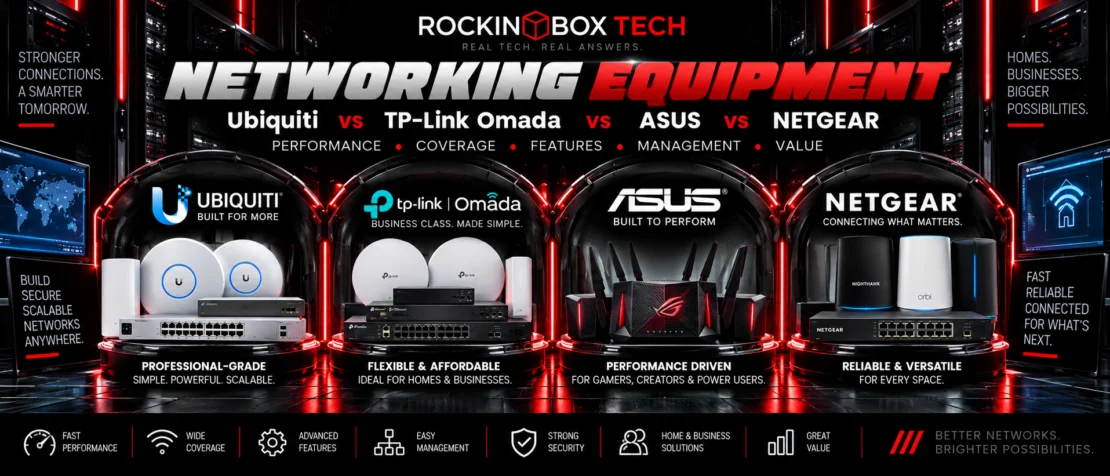
QUICK VERDICT
Ubiquiti UniFi
The strongest complete networking ecosystem in this comparison for prosumer, small-business and multi-site deployments, with gateways, switching, Wi-Fi, cameras, access control and centralized management.
TP-Link Omada
A powerful managed-networking ecosystem offering gateways, switches, access points and centralized administration at very competitive pricing for homes, offices and small businesses.
ASUS
A strong choice for high-performance home networks, gaming, multi-gig internet and users who want extensive router features without building a full business-style managed network.
NETGEAR
NETGEAR combines premium Orbi whole-home mesh systems with Nighthawk performance products and business networking hardware, making it a flexible choice across many network types.
TYPICAL SYSTEM PRICE RANGE
Ubiquiti UniFi
Small UniFi deployments can begin with a gateway or access point, while larger networks may combine gateways, multiple switches, Wi-Fi access points, cameras and other infrastructure.
Total cost depends heavily on network size and selected hardware.
TP-Link Omada
Omada provides relatively inexpensive entry points for managed access points, switches and gateways, while larger deployments can scale into much more substantial networks.
One of the stronger options when infrastructure cost matters.
ASUS
ASUS networking ranges from mainstream routers through premium Wi-Fi 7 and gaming models with multi-gig Ethernet and advanced network-management features.
AiMesh can extend compatible ASUS routers into multi-node systems.
NETGEAR
NETGEAR spans standalone Nighthawk routers, premium Orbi mesh systems and business networking products.
High-end multi-node Orbi systems can reach premium price levels.
SIDE-BY-SIDE COMPARISON
| Feature | Ubiquiti | TP-Link Omada | ASUS | NETGEAR |
|---|---|---|---|---|
| Best For | Prosumer & business networks | Value-focused managed networks | High-performance home users | Premium home & mixed environments |
| Home Networking | Excellent | Excellent | Outstanding | Outstanding |
| Small Business | Outstanding | Outstanding | Limited compared with managed ecosystems | Strong |
| Multi-Site Management | Excellent | Excellent | Not a primary focus | Product-line dependent |
| Centralized Management | Excellent UniFi management | Excellent Omada management | Router / app focused | Varies by product family |
| Gateways / Routers | Extensive | Extensive | Outstanding consumer lineup | Extensive |
| Managed Switches | Extensive | Extensive | Not a core ecosystem strength | Available |
| PoE Networking | Excellent | Excellent | Limited compared with business ecosystems | Strong business options |
| Wireless Access Points | Excellent | Excellent | Router / AiMesh centered | Router, mesh & business AP options |
| Whole-Home Mesh | AP-based roaming design | AP / mesh deployment | AiMesh | Orbi |
| Wi-Fi 7 | Available | Available | Extensive | Extensive |
| Multi-Gig Ethernet | Excellent | Excellent | Excellent | Excellent |
| 10Gb Networking | Available across higher-end hardware | Available on selected hardware | Available on premium routers | Available on selected premium/business gear |
| VLAN Support | Excellent | Excellent | Model / feature dependent | Product-line dependent |
| Guest Networks | Excellent | Excellent | Excellent | Excellent |
| VPN Features | Strong | Strong | Excellent consumer VPN flexibility | Model dependent |
| Gaming Features | Not the primary focus | Not the primary focus | Outstanding | Strong on Nighthawk products |
| Network Security Tools | Strong centralized controls | Strong managed controls | AiProtection and security features | Security features vary by platform |
| Cameras / Surveillance | Deep UniFi integration | Integrated Omada / VIGI direction | Not a core networking feature | Not a core networking feature |
| Ease of Setup | Moderate | Moderate | Easy | Easy |
| Advanced Control | Outstanding | Excellent | Excellent for home users | Good to excellent |
| Scalability | Outstanding | Outstanding | Good | Very good |
| Overall Value | Excellent | Outstanding | Excellent | Good to excellent |
WHAT EACH ECOSYSTEM DOES BEST
Ubiquiti UniFi
Building one integrated network.
UniFi is designed around centralized management of gateways, switching, wireless access points and increasingly other building technology such as surveillance and access control. It is especially attractive when a network needs room to grow.
TP-Link Omada
Managed networking at competitive cost.
Omada provides many of the capabilities businesses expect from a controller-based network while maintaining aggressive hardware pricing. Its expanding gateway, switching, Wi-Fi and surveillance portfolio makes it increasingly comprehensive.
ASUS
High-performance home networking.
ASUS excels when one powerful router or an AiMesh system can handle the job. Premium models offer Wi-Fi 7, multi-gig networking, advanced VPN tools, security functions and extensive gaming optimization without requiring a business-style controller.
NETGEAR
Premium whole-home Wi-Fi.
Orbi remains a major strength for users who want powerful mesh coverage with relatively simple setup, while Nighthawk provides high-performance standalone routing and NETGEAR's business lines extend into switching and professional networking.
PROS & CONS
Ubiquiti UniFi
- Excellent centralized management
- Highly scalable
- Strong gateways, switches and access points
- Multi-site management
- Deep surveillance integration
- Strong prosumer and business capabilities
- No traditional per-device networking license requirement
- More complex than a basic home router
- Easy to spend more as the system grows
- Best experience encourages staying inside UniFi
TP-Link Omada
- Excellent price-to-feature ratio
- Centralized management
- Strong business Wi-Fi options
- Managed PoE switching
- Multi-site capability
- Growing networking and surveillance ecosystem
- More setup knowledge than consumer mesh
- Product naming can be complex
- Some advanced capabilities depend on controller/platform choice
ASUS
- Excellent router performance
- Strong Wi-Fi 7 lineup
- AiMesh flexibility
- Excellent gaming features
- Advanced VPN capabilities
- Multi-gig and 10Gb options
- Strong security feature set
- Not a complete enterprise-style ecosystem
- Premium gaming routers can be expensive
- Less natural for large wired business deployments
NETGEAR
- Excellent Orbi mesh systems
- Strong whole-home coverage
- Powerful Nighthawk routers
- Wi-Fi 7 options
- Business switching available
- Generally easy consumer setup
- Premium Orbi systems can be expensive
- Features vary significantly across product families
- Less unified than UniFi for complete infrastructure deployments
WHO SHOULD CHOOSE WHICH?
Choose Ubiquiti If...
You want to build a serious home, prosumer or small-business network with centralized control over gateways, switches, Wi-Fi and potentially security cameras or other infrastructure.
Choose Omada If...
You need controller-based business networking and strong scalability but want to keep equipment costs under tighter control.
Choose ASUS If...
Your main goal is a fast home network, gaming, multi-gig internet, advanced router features or flexible mesh without deploying a business-style managed network.
Choose NETGEAR If...
You want premium whole-home mesh, straightforward setup or a high-performance Nighthawk router and prefer a more consumer-oriented experience.
BEST NETWORKING PLATFORM BY USE
RBT VERDICT
Overall Edge: Ubiquiti UniFi — But Omada Is an Extremely Strong Value Alternative.
Ubiquiti UniFi earns our overall edge because it provides the most cohesive path from a relatively simple network to a substantial multi-site infrastructure deployment. Gateways, switching, Wi-Fi, surveillance and other systems can all live inside a broadly unified management environment.
TP-Link Omada is the closest challenger when value matters. It delivers controller-based gateways, switches and wireless networking at competitive prices and has continued expanding into a broader unified networking and surveillance platform.
ASUS is the better choice for many technically demanding home users. If you want a powerful Wi-Fi 7 router, gaming optimization, advanced VPN options, AiMesh and multi-gig connectivity without managing a rack full of business hardware, ASUS can make more sense than either UniFi or Omada.
NETGEAR remains particularly compelling for premium whole-home wireless. Orbi is designed around delivering high-performance mesh coverage with less network administration, while Nighthawk serves users who prefer powerful standalone routers.
The most important question is therefore not simply "Which brand is fastest?" It is "What kind of network are you building?" For a managed and expandable infrastructure, start with UniFi or Omada. For a high-performance home router, look closely at ASUS. For premium plug-and-manage whole-home mesh, NETGEAR Orbi remains a strong option.