
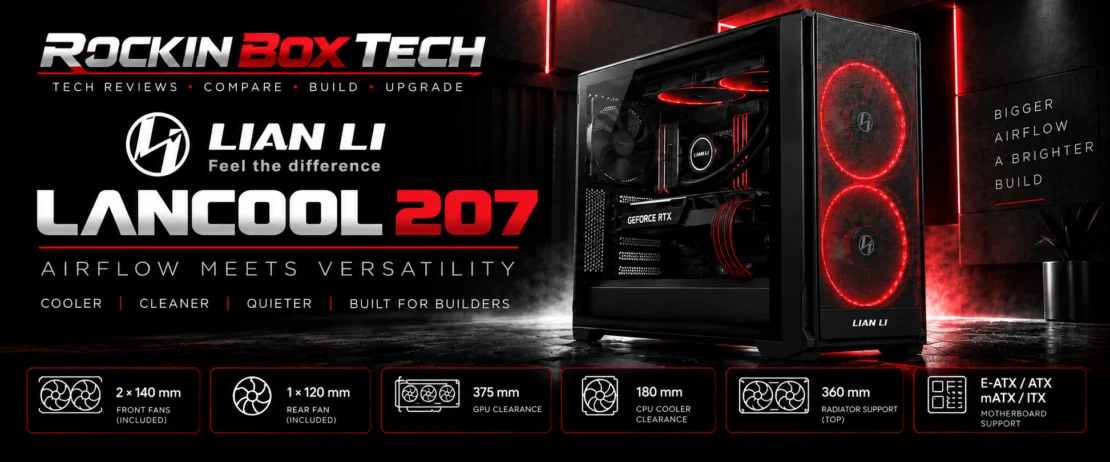
Lian Li LANCOOL 207
A research-driven look at Lian Li's compact performance-focused ATX chassis, combining a mesh airflow design, four included fans, strong GPU cooling, 360 mm top radiator support and space for modern high-performance hardware.
Quick Product Overview
Compact ATX Layout
The LANCOOL 207 is designed to fit full-size ATX hardware into a comparatively compact chassis without sacrificing the airflow expected from a performance-oriented gaming case.
Four Fans Included
Lian Li equips the chassis with two large 140 mm front intake fans plus two 120 mm fans positioned above the PSU chamber to feed additional air toward the graphics card.
GPU-Focused Cooling
The lower fans and ventilated internal layout are designed to deliver fresh intake air directly toward modern high-power graphics cards.
Key Specifications
| Product | Lian Li LANCOOL 207 |
|---|---|
| Case Type | Compact ATX mid-tower |
| Motherboard Support | ATX, Micro-ATX and Mini-ITX |
| GPU Clearance | Up to 375 mm |
| CPU Cooler Clearance | Up to 180 mm |
| PSU Support | ATX power supplies with layout-dependent clearance |
| Expansion Slots | 7 |
| Front Fans Included | 2 × 140 mm ARGB intake fans |
| Lower Fans Included | 2 × 120 mm fans above the PSU chamber |
| Top Fan Support | Up to 3 × 120 mm or 2 × 140 mm |
| Rear Fan Support | 1 × 120 mm |
| Top Radiator Support | Up to 360 mm |
| Side Panel | Tempered glass |
| Front Panel | High-airflow mesh |
| Primary Design Focus | High airflow, GPU cooling and compact ATX hardware support |
Airflow & Cooling Design
Dual 140 mm Front Intake
The mesh front allows the two included 140 mm intake fans to move a broad stream of outside air into the main component chamber.
Dedicated GPU Airflow
Two additional 120 mm fans are positioned below the graphics-card area, helping supply fresh air directly toward the GPU cooler.
Open Exhaust Path
Ventilation at the top and rear provides multiple paths for heated air to leave the chassis, supporting both air-cooled and liquid-cooled builds.
GPU Cooling Strategy
One of the LANCOOL 207's most important design features is the positioning of two intake fans directly beneath the graphics-card area. Instead of depending entirely on air traveling from the front of the chassis, these fans provide another source of fresh air close to the GPU.
This layout is particularly relevant to modern graphics cards because large triple-slot and multi-fan GPUs can consume several hundred watts and release a significant amount of heat inside the chassis.
Hardware Compatibility
Large Graphics Cards
Up to 375 mm of GPU clearance provides enough space for a wide range of current performance graphics cards.
Tower Air Coolers
CPU-cooler clearance of up to 180 mm supports many large single-tower and dual-tower air coolers.
Full ATX Support
Despite the compact external dimensions, the chassis supports standard ATX motherboards in addition to Micro-ATX and Mini-ITX platforms.
Liquid Cooling Support
The LANCOOL 207 supports a large top-mounted radiator, including configurations up to 360 mm. This makes the chassis suitable for many current 240 mm, 280 mm and 360 mm AIO CPU coolers.
Top mounting is particularly useful in this design because it allows builders to retain the case's large front intake fans and dedicated lower GPU fans. Radiator thickness, motherboard heatsinks, memory height and fan thickness should still be considered together when planning a build.
Works Best With
Performance Gaming GPUs
The dedicated lower intake fans make the case particularly attractive for systems centered around powerful modern graphics cards.
Large Air Coolers
The 180 mm CPU-cooler clearance leaves room for many high-performance tower coolers.
360 mm AIO Cooling
Top radiator support gives builders the option of using a large AIO while preserving the factory intake arrangement.
Build Design & Practicality
Space-Efficient Layout
Lian Li rearranges the lower chamber and power-supply position to reduce overall chassis dimensions while retaining ATX component support.
Tempered-Glass Side
The glass side panel provides a clear view of the main hardware while the mesh front keeps the exterior focused on airflow.
Four Stock Fans
Including four fans gives builders a functional cooling configuration without requiring an immediate purchase of a complete aftermarket fan set.
What Published Technical Testing Shows
Independent testing has been especially favorable toward the LANCOOL 207's thermal performance. Professional reviewers have highlighted the effectiveness of its four-fan stock configuration and the direct airflow supplied to the graphics-card area.
The design demonstrates that a relatively compact ATX chassis can still provide strong cooling when fan placement and internal airflow paths are engineered around the components producing the most heat.
Owner Satisfaction & What Builders Are Saying
Positive Feedback
- Cooling performance is one of the most frequently praised characteristics.
- Builders appreciate receiving four useful fans with the chassis.
- The dedicated lower GPU fans are viewed as a meaningful feature rather than decoration.
- Owners often appreciate the relatively compact size for a full ATX build.
- The mesh front and straightforward styling appeal to users who prioritize function over panoramic glass.
- Many builders view the case as providing a strong combination of airflow and practical hardware support.
Concerns & Criticism
- The unusual PSU position can make cable routing different from a traditional ATX case.
- Large power supplies require more careful planning.
- The compact layout provides less unused working space than physically larger enthusiast cases.
- Builders using thick top radiators need to check surrounding component clearance.
- Users seeking a panoramic showcase design may prefer another Lian Li chassis.
Where Research Agrees & Differs
Manufacturer information, professional testing and builder discussion largely agree that airflow is the LANCOOL 207's defining strength. The combination of large front intake fans and dedicated lower GPU fans provides a clear cooling strategy.
Most of the disagreement centers on the compact internal layout. Some builders appreciate getting full ATX capability without a physically large enclosure, while others prefer the additional working and cable-management space available in larger cases.
Strengths & Limitations
Strengths
- Strong airflow-focused design
- Four cooling fans included
- Two 140 mm front intake fans
- Dedicated lower GPU cooling fans
- Up to 375 mm GPU clearance
- Up to 180 mm CPU-cooler clearance
- 360 mm top radiator support
- Full ATX motherboard compatibility
- Relatively compact external footprint
- Strong published thermal performance
Limitations
- Unconventional PSU layout requires planning
- Less working room than larger enthusiast cases
- Large PSUs can complicate cable management
- Thick radiator combinations require clearance checks
- No panoramic dual-glass presentation
- Builders needing E-ATX support should choose a larger chassis
Upgrade & Build Considerations
The 375 mm GPU clearance provides useful room for future graphics-card upgrades, while the dedicated lower intake fans are particularly valuable as GPU power consumption and cooler size increase.
Builders planning a high-end 360 mm AIO should verify radiator and fan thickness against motherboard heatsinks and memory. Large power supplies also deserve careful attention because the LANCOOL 207's compact dimensions depend partly on its unconventional lower-chamber layout.
Alternatives to Consider
Fractal Design Meshify 3
A larger and more conventional airflow-focused alternative with broad hardware compatibility and three 140 mm front fans.
Cooler Master HAF II 500
A substantially larger alternative for builders who want extreme large-fan airflow and significantly greater component clearance.
HAVN BF 360
Another performance-focused alternative emphasizing oversized intake fans, spacious hardware support and enthusiast airflow engineering.
Who Is It Best For?
The Lian Li LANCOOL 207 is particularly well suited to gaming-PC builders who want strong GPU and CPU cooling without moving to an oversized enclosure. Its factory fan configuration makes it especially attractive for users who want useful airflow immediately rather than replacing or adding several fans after purchase.
It is less appropriate for builders who require E-ATX motherboard support, extensive custom-loop hardware or an especially large amount of unused internal working space.
Rockin Box Tech Research Summary
The Lian Li LANCOOL 207 demonstrates that strong airflow does not necessarily require an oversized chassis. Lian Li uses a compact ATX layout with two 140 mm front intake fans and two additional 120 mm fans positioned specifically to feed the graphics card.
That GPU-focused cooling arrangement is one of the case's most important features. Combined with the mesh front and open exhaust path, it gives the LANCOOL 207 a cooling strategy built around where modern gaming systems actually produce heat.
The trade-off is a tighter and less conventional internal layout. PSU size, cable routing and large radiator combinations deserve more planning than they might in a physically larger enclosure.
For builders looking for a relatively compact ATX case with strong published thermal performance, four included fans and room for large gaming hardware, the LANCOOL 207 stands out as a particularly practical airflow-focused design.
Research Sources
Primary specifications: Lian Li official LANCOOL 207 product information and technical documentation.
Independent technical research: Published professional PC-case thermal and build testing was considered when evaluating airflow, GPU cooling and overall chassis performance.
Owner/community research: Current builder discussions and owner experiences were considered for recurring satisfaction points, installation observations and commonly reported concerns.
Research Disclosure
Each review is research-driven and based on manufacturer specifications, technical documentation and reputable published sources.
Products are not necessarily physically tested by Rockin Box Tech.
Cooling performance, temperatures, acoustics and overall build experience can vary according to installed components, fan quantity and speed, radiator configuration, graphics-card size and orientation, CPU cooler, power supply, cable routing, room temperature, dust accumulation and operating conditions.
Owner and community feedback represents individual user experiences and should not be interpreted as controlled laboratory testing.
Product specifications, revisions, accessories, pricing and availability may change after this review is published.