
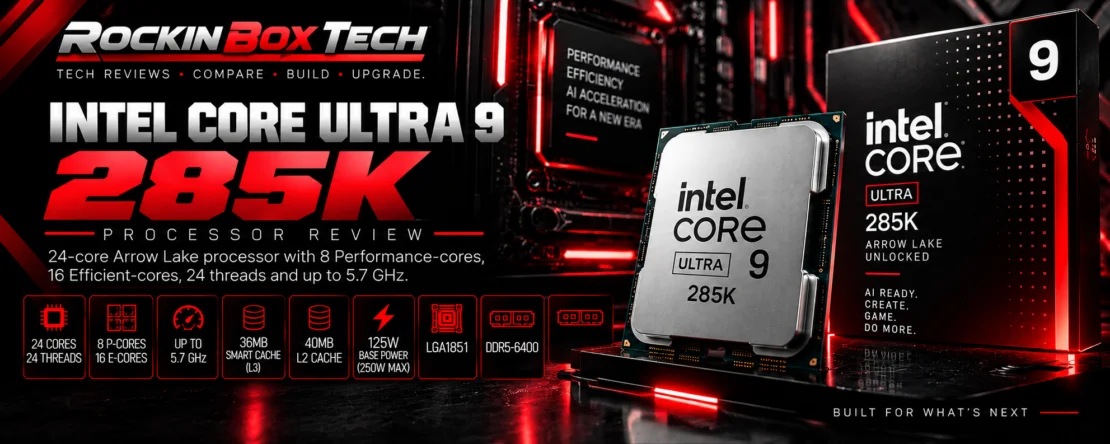
Intel Core Ultra 9 285K
24-core Arrow Lake desktop processor with 8 Performance-cores, 16 Efficient-cores, 24 threads and up to 5.7 GHz.
Quick Product Overview
The Intel Core Ultra 9 285K is Intel's flagship Arrow Lake desktop processor from the Core Ultra Series 2 family. It combines 8 Performance-cores with 16 Efficient-cores for a total of 24 physical cores and 24 threads.
Unlike the previous Core i9-14900K, Arrow Lake removes Hyper-Threading. Each P-core and E-core contributes one thread, while the redesigned architecture places greater emphasis on efficiency, platform modernization and integrated AI acceleration.
The processor introduces the newer LGA1851 platform, DDR5-only memory support, 24 CPU PCIe lanes, integrated Intel Graphics and an Intel AI Boost NPU.
Key Specifications
| Processor | Intel Core Ultra 9 285K |
|---|---|
| Product Family | Intel Core Ultra Processors Series 2 |
| Code Name | Arrow Lake |
| CPU Lithography | TSMC N3B |
| Total Cores | 24 |
| Performance-cores | 8 |
| Efficient-cores | 16 |
| Total Threads | 24 |
| Hyper-Threading | No |
| Maximum Turbo Frequency | Up to 5.7 GHz |
| Thermal Velocity Boost | Up to 5.7 GHz |
| Turbo Boost Max 3.0 | Up to 5.6 GHz |
| P-Core Maximum Turbo | Up to 5.5 GHz |
| E-Core Maximum Turbo | Up to 4.6 GHz |
| P-Core Base Frequency | 3.7 GHz |
| E-Core Base Frequency | 3.2 GHz |
| Intel Smart Cache | 36 MB |
| Total L2 Cache | 40 MB |
| Processor Base Power | 125W |
| Maximum Turbo Power | 250W |
| Socket | FCLGA1851 |
| Maximum Memory | Up to 256 GB |
| Memory Type | DDR5 only |
| Official Memory Speed | Up to DDR5-6400 |
| Memory Channels | 2 |
| ECC Support | Yes, platform dependent |
| PCI Express | PCIe 5.0 and PCIe 4.0 |
| Maximum CPU PCIe Lanes | 24 |
| Integrated Graphics | Intel Graphics |
| Graphics Xe-Cores | 4 |
| Graphics Max Frequency | 2.0 GHz |
| NPU | Intel AI Boost |
| NPU Performance | 13 TOPS |
| Overall Peak AI Performance | 36 TOPS |
| Intel Thread Director | Supported |
| Unlocked Multiplier | Yes |
| Maximum Operating Temperature | 105°C |
| Launch | Q4 2024 |
| Intel Recommended Customer Price | $589–$599 |
Performance & Use-Case Information
Productivity
Independent testing shows the 285K performing particularly well in many heavily threaded productivity applications, making this one of its strongest use cases.
Gaming
Gaming performance is less impressive. Reviewers found that the 285K can fall behind the older Core i9-14900K and AMD's gaming-focused X3D processors in many titles.
Content Creation
Rendering, encoding and other creator workloads benefit from the processor's 24 physical cores and improved efficiency.
AI Workloads
Arrow Lake adds a dedicated Intel AI Boost NPU alongside CPU and integrated-GPU AI acceleration for supported software.
Media Work
Integrated Intel Graphics provides Quick Sync Video support, including hardware AV1 encode and decode.
Mixed Workloads
The 285K is most compelling when productivity, efficiency and modern platform features matter more than maximizing gaming frame rates.
What Arrow Lake Changes
Core Ultra 200S represents a substantial architectural change from the Raptor Lake generation. Intel moved to a tile-based design and introduced a new LGA1851 desktop platform.
The Core Ultra 9 285K retains 24 physical cores, but drops Hyper-Threading. This means its 8 P-cores and 16 E-cores produce exactly 24 threads rather than the 32 threads provided by the older Core i9-14900K.
The platform also moves to DDR5-only memory, provides 24 CPU PCIe lanes, and introduces an integrated NPU for local AI acceleration.
Power Efficiency & Thermals
Intel specifies a 125W Processor Base Power and 250W Maximum Turbo Power.
One of Arrow Lake's more consistent advantages in independent reviews is improved power behavior compared with the Core i9-14900K. Tom's Hardware specifically highlighted reduced power consumption and improved efficiency as strengths of the new design.
Cooling requirements remain substantial for sustained high-load use, but the 285K is generally easier to cool than the most aggressive Raptor Lake Refresh configurations.
Platform & Compatibility
LGA1851 Socket
The 285K uses Intel's newer LGA1851 socket and is not compatible with older LGA1700 motherboards.
Z890 Platform
Intel's Z890 chipset is the natural enthusiast pairing for the unlocked 285K because it supports CPU, BCLK and memory overclocking.
DDR5 Only
Unlike the 14900K generation, Arrow Lake does not support DDR4. Intel officially lists DDR5 speeds up to 6400 MT/s.
Other 800-Series Chipsets
Intel also lists B860, H810, Q870 and W880 chipset families as compatible with the Core Ultra 9 285K.
Works Best With
These are examples of well-matched enthusiast components, not mandatory purchases. Always verify BIOS version, exact memory support, cooler mounting and case dimensions before buying.
MSI MAG Z890 TOMAHAWK WIFI
A Z890 LGA1851 motherboard is a natural enthusiast-class pairing for the unlocked 285K, with DDR5 support and modern PCIe connectivity.
G.SKILL Trident Z5 DDR5
A quality Intel XMP DDR5 kit is a strong match for Z890. Intel officially supports up to DDR5-6400, while higher XMP speeds operate as memory overclocking.
ARCTIC Liquid Freezer III 360
A high-capacity liquid cooler is a suitable choice for sustained high-load operation, provided the selected cooler includes compatible LGA1851 mounting hardware.
Integrated AI Acceleration
The Core Ultra 9 285K includes an Intel AI Boost NPU rated at 13 TOPS, while Intel lists the processor's overall peak AI capability at 36 TOPS when CPU, GPU and NPU resources are considered.
The NPU is intended for supported local AI workloads that can run more efficiently on dedicated acceleration hardware rather than occupying the CPU or discrete GPU.
The 285K should not be confused with higher-NPU-performance mobile Core Ultra platforms. Its desktop strength remains CPU performance, platform connectivity and efficiency rather than NPU performance alone.
Integrated Intel Graphics
The Core Ultra 9 285K includes integrated Intel Graphics with 4 Xe-cores and a maximum dynamic frequency of 2.0 GHz.
Intel Quick Sync Video is supported, along with hardware H.264, H.265 and AV1 encode/decode. A discrete graphics card remains the expected choice for a high-end gaming system.
What Independent Reviewers Found
Tom's Hardware
Tom's Hardware found significant strengths in productivity, efficiency, memory support and cooling behavior, but identified weaker gaming performance as the processor's major drawback.
TechSpot
TechSpot's launch review was considerably more critical, finding inconsistent gaming results and noting that the 285K could lose to both prior-generation Intel processors and AMD rivals.
Platform Improvements
Reviewers generally agreed that Arrow Lake provides meaningful architectural and platform changes even where raw gaming performance does not move forward.
Where Reviewers Agree — And Where Context Matters
Where They Generally Agree
- Strong productivity performance
- Improved power behavior over the 14900K
- Modern LGA1851 / Z890 platform
- DDR5-6400 support
- Integrated NPU and improved media features
- More manageable thermals than prior flagship Intel CPUs
Where Context Matters
- Gaming can regress versus the Core i9-14900K
- AMD X3D processors remain stronger gaming choices
- No DDR4 compatibility
- Requires a new LGA1851 motherboard
- Launch pricing was difficult to justify for gaming-first buyers
- Application performance varies significantly by workload
Strengths & Limitations
Strengths
- 24 physical cores
- Strong productivity performance
- Improved efficiency versus prior-generation Intel flagships
- Up to 5.7 GHz turbo
- 40MB L2 cache
- DDR5-6400 support
- 24 CPU PCIe lanes
- Integrated Intel Graphics
- Dedicated NPU
- Unlocked multiplier
Limitations
- Gaming performance can trail the 14900K
- AMD X3D CPUs are often faster for gaming
- No Hyper-Threading
- No DDR4 support
- Requires LGA1851 motherboard
- Premium platform cost
- No boxed cooler included
Upgrade Considerations
From Core i9-14900K
The 285K should not be viewed as a straightforward gaming upgrade from the 14900K. Its stronger reasons to upgrade are platform modernization, efficiency and selected productivity workloads.
From Older Intel Platforms
Buyers moving from substantially older Intel systems gain a new socket, DDR5-only memory, newer connectivity and a major architectural redesign in addition to CPU performance.
For New Builds
The 285K is best considered for productivity-focused high-end builds where its efficiency and platform features matter more than absolute gaming performance.
Alternatives to Consider
Intel Core Ultra 7 270K Plus
A newer Series 2 option with the same 8 P-core + 16 E-core configuration and 24 threads, but lower peak clock and a substantially lower official price.
Intel Core i9-14900K
The older LGA1700 flagship can still be competitive or faster in gaming, though it carries substantially higher power and thermal demands.
AMD Ryzen 9 9950X3D
A strong alternative for buyers who want both high-end productivity performance and class-leading gaming capability.
Who Is It Best For?
Productivity Users
Rendering, encoding, compiling and other demanding workloads where the processor's 24 physical cores can be effectively used.
New Intel Builds
Buyers specifically wanting Intel's newer LGA1851 desktop platform, DDR5-6400 support and expanded CPU PCIe connectivity.
Efficiency-Focused Power Users
Users who want flagship Intel productivity performance without the same extreme power and thermal behavior associated with the Core i9-14900K generation.
Rockin Box Tech Research Summary
Research from Intel's official documentation and independent testing shows the Core Ultra 9 285K to be a major architectural change, but not a universal performance upgrade.
Its strongest areas are productivity, efficiency, memory support and platform modernization. The new LGA1851 platform adds DDR5-only operation, 24 CPU PCIe lanes, integrated AI acceleration and improved media capabilities.
Gaming is the major weakness. Independent reviewers found the processor could trail the older Core i9-14900K in gaming and frequently lose to AMD's X3D processors.
In 2026, the 285K therefore makes the most sense for buyers who prioritize productivity, efficiency and Intel's newer desktop platform rather than buyers seeking the highest possible gaming frame rates.