
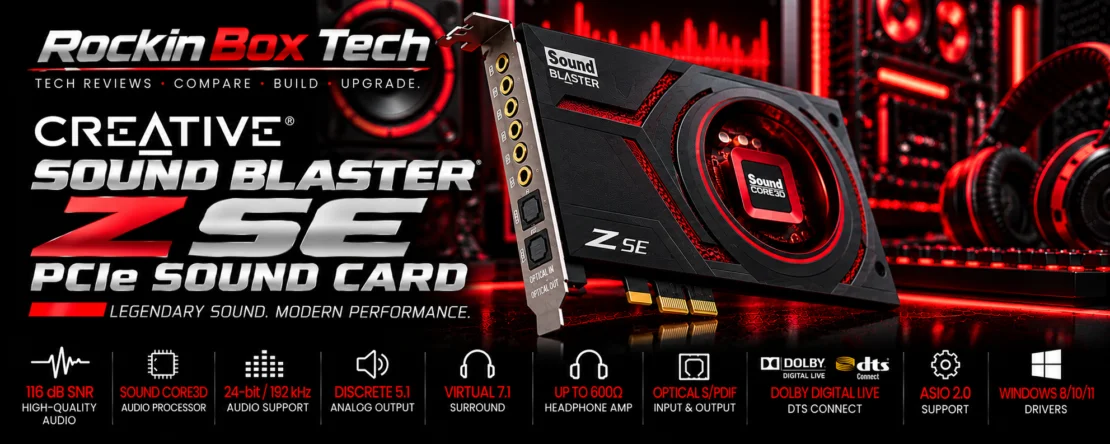
Creative Sound Blaster Z SE PCIe Sound Card Review
A proven internal PCIe sound card combining discrete 5.1 speaker output, virtual 7.1 headphone surround, 116 dB SNR, optical digital I/O and amplification for headphones up to 600 ohms.
What It Is
The Creative Sound Blaster Z SE is an internal PCI Express sound card designed for desktop gaming, entertainment, headphones and multichannel speaker systems.
It combines Creative's Sound Core3D audio processor with discrete 5.1-channel analog speaker output, virtual 7.1 surround processing, an amplified headphone connection and both optical S/PDIF input and output.
The Z SE occupies a different position from Creative's newer high-end AE-series cards. Rather than competing with the AE-7 or AE-9 on flagship DAC specifications, it provides a mature mixture of analog surround connectivity, digital I/O, headphone support and Creative's software processing at a lower tier.
Key Specifications
| Model | Creative Sound Blaster Z SE |
|---|---|
| Platform | PC |
| Interface | PCI Express x1 |
| Audio Processor | Sound Core3D |
| Signal-to-Noise Ratio | 116 dB |
| Maximum Audio Fidelity | Up to 24-bit / 192 kHz |
| 192 kHz Operation | Stereo Direct Mode |
| Multichannel Analog | Discrete 5.1 |
| Virtual Surround | Virtual 7.1 |
| Speaker Outputs | 3 × 3.5 mm — Front, Rear, Center/Subwoofer |
| Headphone Output | Amplified 3.5 mm |
| Headphone Impedance | 32–600Ω |
| Analog Input | 3.5 mm Line / Microphone input |
| Digital Input | Optical TOSLINK |
| Digital Output | Optical TOSLINK |
| Surround Encoding | Dolby Digital Live / DTS Connect |
| ASIO | ASIO 2.0 |
| Front-Panel Audio | Intel HD Audio header |
| Power | PCI Express bus powered |
| Official OS Support | Windows 8, Windows 10 and Windows 11 |
Sound Core3D Processing
Creative's Sound Core3D processor handles the Z SE's audio processing and works with the Sound Blaster Command software suite.
Surround Processing
Creative's processing can create virtual surround presentation for headphones and compatible speaker configurations.
Audio Enhancement
Sound Blaster Command provides configurable processing including surround, Crystalizer, bass and other listening adjustments.
Gaming Profiles
The Z SE includes Creative's SBX gaming-oriented profiles for users who want preset processing rather than configuring every setting manually.
116 dB Signal-to-Noise Ratio
Creative specifies a 116 dB signal-to-noise ratio for the Sound Blaster Z SE.
That specification places the Z SE above basic low-cost expansion cards such as the connectivity-oriented StarTech and Vantec models in this review series, although Creative's AE-series cards offer still higher published performance specifications.
24-bit / 192 kHz Playback
The Z SE supports audio fidelity up to 24-bit / 192 kHz.
Stereo Direct Mode
The highest 192 kHz playback mode applies to stereo Direct Mode, providing a path intended for straightforward two-channel playback.
Multichannel Playback
Creative specifies up to 24-bit / 96 kHz operation for 5.1-channel analog output rather than 192 kHz across all channels simultaneously.
Discrete 5.1 Speaker Output
The Sound Blaster Z SE provides three analog 3.5 mm speaker outputs for front, rear and center/subwoofer channels.
True Analog 5.1
Compatible 5.1 PC speaker systems can connect directly to the card without relying on HDMI or an external USB audio device.
Separate Analog Outputs
Dedicated front, rear and center/subwoofer connections make the Z SE particularly relevant to desktop users who still operate traditional analog surround-speaker systems.
Virtual 7.1 Surround
The Z SE also supports virtual 7.1 surround processing.
This is different from its physical speaker connectivity. The card provides discrete analog output for up to 5.1 speakers; 7.1 is a virtualized surround mode rather than eight discrete analog speaker channels.
Headphone Amplification up to 600Ω
Creative provides a dedicated amplified 3.5 mm headphone output and specifies support for headphones from 32Ω through 600Ω.
Gaming Headsets
Conventional wired gaming headphones fall comfortably within the card's intended headphone range.
Higher-Impedance Headphones
The published 600Ω ceiling gives the Z SE considerably broader headphone compatibility than cards without a dedicated amplified output.
Virtual Surround
Headphone users can combine the amplified output with Creative's virtual 7.1 processing when desired.
Optical S/PDIF Input & Output
Unlike many inexpensive PCIe audio cards that provide only digital output, the Sound Blaster Z SE includes both optical TOSLINK input and output.
Optical Input
Compatible digital audio equipment can send an optical signal into the PC through the card's TOSLINK input.
Optical Output
The PC can send digital audio to compatible receivers, speaker systems, DACs and other optical equipment.
Creative specifies optical PCM operation up to 24-bit / 96 kHz along with support for compatible Dolby Digital and DTS workflows.
Dolby Digital Live & DTS Connect
The Z SE supports Dolby Digital Live and DTS Connect encoding. This can be useful when sending multichannel game or PC audio to compatible external equipment through the optical connection.
Dolby Digital Live
Compatible multichannel PC audio can be encoded for transmission to supported Dolby Digital playback equipment.
DTS Connect
DTS encoding provides another supported route for compatible external surround equipment.
Sound Blaster Command
Creative's Sound Blaster Command software provides access to the Z SE's processing and configuration features.
SBX Profiles
Users can apply and customize Creative's gaming and entertainment-oriented audio processing.
Microphone EQ
The Z SE includes microphone EQ presets intended to adjust headset microphone characteristics for voice communication.
Output Configuration
Speaker, headphone, surround and other audio settings are managed through Creative's software environment.
Windows 11 Compatibility
Modern operating-system support is one of the most important reasons the Sound Blaster Z SE remains relevant to this review category.
Windows 11
Creative explicitly lists Windows 11 among the Sound Blaster Z SE's supported operating systems.
Windows 10
Windows 10 32-bit and 64-bit environments are included in Creative's published system requirements.
Windows 8
Creative also lists Windows 8 32-bit and 64-bit support, satisfying the minimum OS requirement established for this Rockin Box Tech category.
Z SE vs Creative AE-Series
The Z SE and Creative's AE-series cards overlap in purpose but should not be treated as equivalent products.
Z SE
Focuses on a mature combination of 5.1 analog connectivity, optical input/output, 600Ω headphone support and Creative processing at a lower product tier.
AE-5 Plus
Moves to a newer SABRE-based DAC architecture, higher published dynamic range and Creative's Xamp headphone amplification.
AE-7 / AE-9
Target progressively higher-end users with stronger published DAC specifications, Xamp amplification and additional premium hardware features.
The Z SE therefore makes the most sense when its connectivity, mature platform and price are more important than obtaining the highest specifications in Creative's internal-card lineup.
What Owners Are Saying
Exact-model consumer feedback is generally favorable toward sound quality, but the available samples also contain useful cautions.
Sound Quality
Positive owners frequently describe a noticeable audio improvement over the motherboard audio they replaced and praise the card's overall sound presentation.
Installation
Several owners report straightforward physical installation and successful setup after installing Creative's current software and drivers.
Software & Reliability
Negative reports include driver or software concerns, memory usage complaints and isolated reports of hardware problems or shorter-than-expected service life.
Where the Sound Blaster Z SE Makes Sense
Windows 11 Gaming PCs
Official Windows 11 support makes the Z SE a viable internal sound-card option for modern desktop builds.
5.1 Analog Speakers
Owners of traditional analog surround systems receive dedicated front, rear and center/subwoofer outputs.
Wired Headphones
The amplified 32–600Ω headphone output supports a broad range of conventional gaming and enthusiast headphones.
Optical Equipment
Separate TOSLINK input and output make the card useful in systems that still rely heavily on optical digital audio.
Gaming Audio Processing
Sound Blaster Command and SBX processing provide considerably more customization than a simple generic PCIe audio adapter.
Motherboard Audio Upgrades
The Z SE is most compelling when its amplification, surround connections, optical I/O or software features solve a specific limitation of the motherboard's integrated audio.
Strengths & Limitations
Strengths
- True internal PCI Express x1 sound card
- Official Windows 11 support
- Official Windows 10 and Windows 8 support
- Sound Core3D audio processor
- 116 dB signal-to-noise ratio
- Up to 24-bit / 192 kHz stereo playback
- Discrete 5.1 analog speaker output
- Virtual 7.1 surround processing
- Amplified headphone output
- 32–600Ω headphone support
- Optical S/PDIF input
- Optical S/PDIF output
- Dolby Digital Live
- DTS Connect
- ASIO 2.0 support
- Intel HD front-panel audio header
- Sound Blaster Command software
Limitations
- Discrete analog output stops at 5.1 rather than 7.1
- 7.1 surround is virtual rather than discrete analog 7.1
- 192 kHz maximum applies to stereo Direct Mode
- 5.1 analog playback is limited to lower sample rates
- Older underlying platform than Creative's AE-series
- Lower published SNR than AE-5 Plus, AE-7 and AE-9
- No AE-series Xamp discrete headphone bi-amplifier
- Requires an available PCIe expansion slot
- Creative software is an important part of configuration
- Some owners report driver/software frustrations
- Isolated consumer reports describe reliability problems
- Modern motherboard audio may already satisfy basic users
Works Best With
Modern Windows Gaming PCs
Official Windows 11 support makes the Z SE considerably easier to justify in a current PC than unsupported legacy sound cards.
5.1 Speakers & Wired Headphones
Users switching between traditional analog surround speakers and amplified wired headphones can take advantage of both sides of the card's hardware.
Optical Receivers & Audio Gear
Two-way TOSLINK connectivity and surround encoding make the Z SE particularly useful in PCs integrated with compatible digital home-audio equipment.
Rockin Box Tech Summary
The Creative Sound Blaster Z SE earns its position in this internal sound-card lineup by combining a mature PCIe platform with features that remain useful in a modern desktop.
Its 116 dB SNR, 24-bit / 192 kHz stereo capability, discrete 5.1-channel analog output and amplified headphone connection give it considerably more audio-focused hardware than a basic PCIe expansion card.
Connectivity is another major strength. The Z SE provides both optical input and output, analog surround connections, headphone amplification and line/microphone input. Dolby Digital Live and DTS Connect further increase its usefulness with compatible external surround equipment.
Creative's official Windows 11 support is especially important. Internal sound cards are a relatively narrow market in 2026, and older cards can become difficult to recommend when their manufacturers stop maintaining modern drivers. The Z SE avoids that particular problem.
There are still limitations. Its underlying platform is older than Creative's AE-series, discrete analog surround stops at 5.1, and its maximum 192 kHz mode does not apply to every output configuration. Users also need to be comfortable with Creative's driver and Sound Blaster Command software environment.
Consumer feedback provides useful context. Owners commonly praise its sound quality and improvement over onboard audio, while some reports describe software, driver or reliability frustrations. Those reports are worth considering without treating isolated experiences as universal.
For a current Windows desktop that specifically needs analog 5.1, optical input/output, strong wired-headphone support or Creative's gaming-oriented processing, the Sound Blaster Z SE remains a practical internal sound-card option rather than simply a legacy product surviving on old specifications.
Research Disclosure: Rockin Box Tech reviews are research-driven. Technical information is compiled from current manufacturer specifications, manuals, driver/support information, independent sources where applicable and available consumer feedback. Rockin Box Tech does not represent that this product was physically tested unless explicitly stated. Manufacturer specifications are treated as technical claims, while owner reports are treated as anecdotal consumer experience rather than controlled testing. Driver support, operating-system compatibility, pricing and product availability may change over time.