
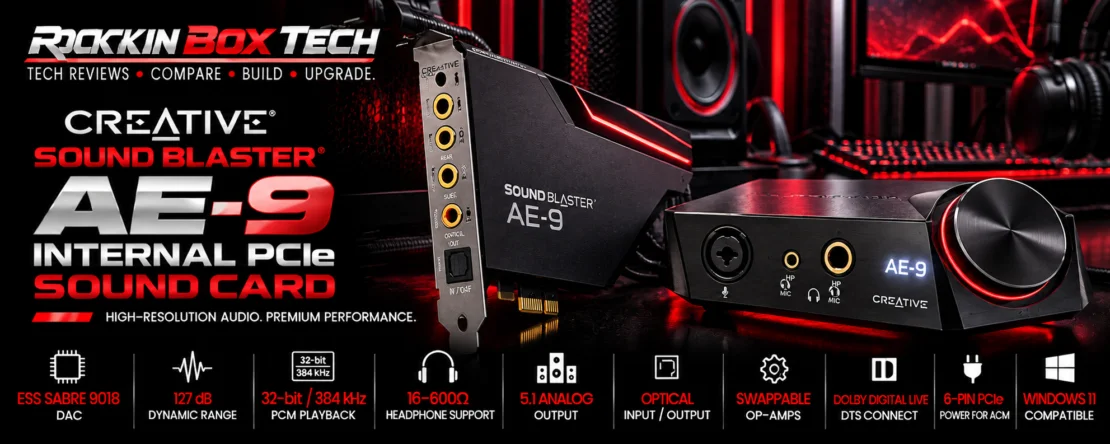
Creative Sound Blaster AE-9 Internal Sound Card Review
Creative's flagship internal PCIe sound card combines a high-resolution ESS SABRE-class DAC, discrete headphone amplification, 5.1 analog output and a dedicated desktop Audio Control Module.
What It Is
The Creative Sound Blaster AE-9 is a premium internal PCIe sound card designed for desktop PCs where onboard motherboard audio is not enough for the user's speakers, headphones, recording inputs or audio-routing requirements.
At its core is an ESS SABRE-class 9038 DAC rated by Creative for a 129 dB stereo dynamic range and up to 32-bit / 384 kHz PCM playback in Direct Mode. DSD64 playback is also supported.
The package combines the internal PCIe card with Creative's external Audio Control Module, giving the user desktop access to headphone connections, microphone input, RCA line input and a large multifunction volume control.
Key Specifications
| Model | Creative Sound Blaster AE-9 |
|---|---|
| Interface | PCI Express |
| Audio Processor | Sound Core3D |
| DAC | ESS SABRE-class 9038 |
| Stereo Dynamic Range | 129 dB |
| DAC THD+N | 0.0001% |
| ADC Dynamic Range | 123 dB |
| ADC THD+N | 0.0004% |
| Maximum Direct-Mode PCM | Up to 32-bit / 384 kHz stereo |
| DSD | DSD64 / 2.8 MHz |
| Analog Surround | Discrete 5.1 output |
| Optical | TOSLINK optical input and output |
| Headphone Amplifier | Xamp discrete headphone bi-amplifier |
| Supported Headphones | 16–600Ω |
| Headphone Output Impedance | 1Ω |
| Normal Gain | 32–149Ω / 3V RMS |
| High Gain | 150–600Ω / 5.3V RMS |
| Operating Systems | Windows 8 / 8.1 / 10 / 11 |
| Main Card Dimensions | 178 × 22 × 127 mm |
| Main Card Weight | 230 g |
| ACM Dimensions | 150 × 128 × 65 mm |
| ACM Weight | 480 g |
| Additional Power | 6-pin PCIe power connection required for the ACM |
ESS SABRE-Class 9038 DAC
The AE-9's headline audio component is its ESS SABRE-class 9038 reference DAC. Creative specifies a 129 dB stereo dynamic range and 0.0001% THD+N.
129 dB DNR
The published dynamic-range specification places the AE-9 well above the basic audio implementations found on many mainstream motherboards.
32-bit / 384 kHz
Direct Mode supports PCM playback up to 32-bit / 384 kHz stereo for compatible high-resolution audio sources.
DSD64
Native DSD64 playback support expands the card's usefulness for enthusiasts maintaining compatible high-resolution music libraries.
Xamp Discrete Headphone Bi-Amplifier
Creative's Xamp design uses discrete amplification for the left and right headphone channels rather than treating headphone output as an afterthought.
IEM Range
Creative specifies a 16–31Ω setting delivering up to approximately 1.5V RMS for sensitive headphones and IEMs.
Normal Gain
Headphones between 32 and 149Ω use the normal-gain range, specified at up to 3V RMS.
High Gain
The high-gain setting supports 150–600Ω headphones and is specified for up to 5.3V RMS.
Audio Control Module
The Audio Control Module is one of the AE-9's defining practical features. Instead of reaching behind the computer every time a headphone or microphone needs to be connected, frequently used controls and connections can remain on the desktop.
Desktop Volume Control
A large multifunction knob provides convenient physical volume adjustment without relying entirely on Windows controls.
Headphone Connections
Both 3.5 mm and 6.3 mm headphone outputs are provided on the ACM for easier access.
Input Access
The module includes microphone input and RCA line inputs, keeping commonly used connections within reach.
The 6-Pin Power Requirement
The AE-9 itself receives power through the PCIe bus, but the Audio Control Module requires additional +12V power through a 6-pin PCIe power connector.
5.1 Analog Surround
The AE-9 provides discrete analog output for 5.1-channel speaker systems using RCA front outputs plus 3.5 mm rear and center / subwoofer outputs.
This remains useful for desktop PC users who own analog surround speakers and want a dedicated sound card rather than routing all multichannel audio through HDMI.
Optical Input & Output
Unlike many simpler internal sound cards, the AE-9 provides both TOSLINK optical input and optical output.
Optical Input
Allows compatible digital sources to feed audio into the AE-9 without converting to analog first.
Optical Output
Provides digital audio output to compatible receivers, DACs and other optical-equipped audio hardware.
Swappable Op-Amps
Creative equips the AE-9 with swappable operational amplifiers, giving experienced enthusiasts another level of hardware customization.
CleanLine Technology
Creative developed CleanLine Technology to filter and isolate noise along the microphone signal path.
The feature is particularly relevant to gaming and voice communication because high-performance desktop PCs can contain electrically noisy components operating very close to the sound card.
Sound Blaster Processing
The AE-9 is not simply a DAC mounted on a PCIe card. Creative's Sound Core3D processor also provides the Sound Blaster processing features that distinguish the AE series from minimalist audiophile DACs.
Acoustic Engine
Creative provides software-controlled audio processing for users who want to alter the presentation rather than run the card completely unprocessed.
Scout Mode
A gaming-oriented processing option intended to emphasize selected audio cues in compatible gaming situations.
Direct Mode
Users who prefer a more straightforward signal path can use Direct Mode and bypass much of the additional Sound Blaster processing.
Where an Internal Sound Card Still Makes Sense
High-Impedance Headphones
The 16–600Ω Xamp implementation gives desktop headphone users considerably more flexibility than a basic motherboard headphone jack.
Analog 5.1 Systems
Users maintaining high-quality analog surround speakers still benefit from dedicated multichannel analog outputs.
Desktop Audio Enthusiasts
The combination of high-resolution DAC, optical I/O, RCA outputs and the ACM provides more routing flexibility than ordinary onboard audio.
Internal Card vs Modern Onboard Audio
Modern motherboard audio has improved significantly, especially on better enthusiast-class boards. That means a premium internal sound card should solve an actual requirement rather than being treated as an automatic upgrade for every PC.
AE-9 Advantages
Powerful headphone amplification, desktop controls, optical input and output, RCA front outputs, 5.1 analog output, high-resolution conversion and Creative's processing suite provide capabilities that many motherboard implementations do not combine in one package.
Onboard Audio Advantages
It is already included with the motherboard, consumes no additional expansion slot, requires no separate card purchase and may already provide adequate quality for ordinary speakers, gaming headsets and everyday listening.
Strengths & Limitations
Strengths
- True internal PCIe sound card
- ESS SABRE-class 9038 DAC
- 129 dB stereo dynamic range specification
- Up to 32-bit / 384 kHz PCM in Direct Mode
- DSD64 playback
- Xamp discrete headphone bi-amplifier
- 16–600Ω headphone support
- Low 1Ω headphone output impedance
- Discrete analog 5.1 speaker output
- TOSLINK optical input and output
- RCA front-channel outputs
- Desktop Audio Control Module
- Swappable op-amps
- CleanLine microphone technology
- Windows 11 officially supported
Limitations
- Premium price compared with onboard audio
- Requires an available PCIe slot
- ACM requires a 6-pin PCIe power connection
- Windows-focused platform
- No native macOS support listed
- Physical analog speaker output is 5.1, not discrete 7.1
- Software is part of the overall ownership experience
- Many users with strong modern onboard audio may not need it
- Desktop ACM adds another cable and device to the desk
- High-resolution specifications do not guarantee an audible improvement in every system
Works Best With
Headphone Enthusiasts
Particularly useful when a desktop PC needs to drive a wide range of headphones without adding a separate external headphone amplifier.
Analog Speaker Systems
A strong fit for users maintaining quality stereo or 5.1 analog speakers and wanting dedicated line-level outputs.
Gaming & Media PCs
Creative's processing features, microphone path, headphone amplification and desktop controls are particularly relevant to a PC used for gaming, music, movies and voice communication.
Rockin Box Tech Summary
The Sound Blaster AE-9 represents the high end of Creative's internal PCIe sound-card approach. Rather than simply providing another analog output, it combines an ESS SABRE-class 9038 DAC, Sound Core3D processing, dedicated headphone amplification and substantial analog and digital connectivity.
The Xamp headphone stage is one of its strongest practical features. Creative supports headphones from 16 to 600Ω and provides separate gain ranges, while the 1Ω output impedance also makes the design more suitable for sensitive low-impedance headphones than many older PC audio outputs.
The Audio Control Module changes how the card is used day to day. Headphones, microphone and line-level sources can remain within reach on the desktop instead of requiring constant access to the rear of the computer.
The AE-9 also preserves capabilities that have become less common in mainstream PC audio: discrete analog 5.1, RCA front outputs, optical input as well as output, swappable op-amps and dedicated hardware audio processing.
There are meaningful tradeoffs. It occupies a PCIe slot, the ACM requires additional 6-pin PCIe power, and the complete experience depends partly on Creative's Windows software and drivers. It is also far more hardware than someone using inexpensive powered speakers or an ordinary gaming headset is likely to require.
Modern onboard audio has improved enough that the question is no longer simply whether a dedicated sound card is technically better. The more useful question is whether the PC needs the AE-9's headphone power, connections, desktop controls, analog surround outputs or Sound Blaster processing.
For a desktop system that genuinely needs those capabilities, the AE-9 provides a substantial internal audio platform and gives us an appropriate high-end reference point for the rest of this Rockin Box Tech internal sound-card category.
Research Disclosure: Rockin Box Tech reviews are research-driven. Technical information is compiled from current manufacturer specifications, documentation and available independent sources. Rockin Box Tech does not represent that this product was physically tested unless explicitly stated. Manufacturer performance specifications are identified as such, and subjective listening experience should not be inferred from specifications alone. Software, drivers, compatibility, pricing and availability may change over time.