
Creative Sound Blaster AE-7 Internal Sound Card Review
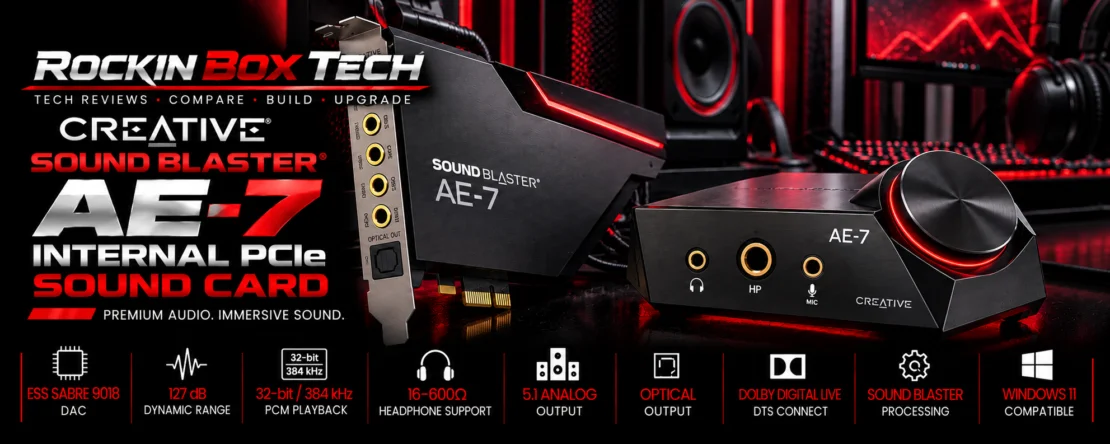
A premium internal PCIe sound card combining an ESS SABRE-class 9018 DAC, Xamp discrete headphone amplification, 5.1 analog surround and Creative's desktop Audio Control Module.
What It Is
The Creative Sound Blaster AE-7 is an internal PCIe sound card positioned below the flagship AE-9 while retaining many of the features that make the higher-end AE series attractive for gaming, music and headphone listening.
Its core hardware includes an ESS SABRE-class 9018 DAC rated by Creative for 127 dB stereo dynamic range and 0.0001% THD+N. Direct Mode supports PCM playback up to 32-bit / 384 kHz along with DSD64.
Creative also includes its Xamp discrete headphone bi-amplifier, discrete 5.1 analog speaker output, optical digital output and an Audio Control Module that brings headphone, microphone and volume controls onto the desktop.
Key Specifications
| Model | Creative Sound Blaster AE-7 |
|---|---|
| Platform | Internal PCI Express |
| Audio Processor | Sound Core3D |
| DAC | ESS SABRE-class 9018 |
| Stereo Dynamic Range | 127 dB |
| DAC THD+N | 0.0001% |
| Maximum Direct-Mode PCM | Up to 32-bit / 384 kHz stereo |
| DSD Playback | DSD64 / 2.8 MHz |
| Analog Speaker Output | Discrete 5.1 |
| Headphone Surround | Virtual 7.1 |
| Digital Output | TOSLINK optical output |
| Headphone Amplifier | Xamp discrete headphone bi-amplifier |
| Headphone Impedance | 16–600Ω |
| Headphone Output Impedance | 1Ω |
| IEM Range | 16–31Ω / up to 1.9V RMS |
| Normal Gain | 32–149Ω / up to 3V RMS |
| High Gain | 150–600Ω / up to 5.6V RMS |
| Power | PCIe bus power |
| Supported OS | Windows 8 / 8.1 / 10 / 11 |
| Main Card Dimensions | 145 × 20 × 128 mm |
| Main Card Weight | 215 g |
| ACM Dimensions | 100 × 92 × 70 mm |
| ACM Weight | 284 g |
ESS SABRE-Class 9018 DAC
The AE-7 uses an ESS SABRE-class 9018 DAC. Creative rates the stereo output at 127 dB dynamic range with 0.0001% THD+N.
127 dB DNR
The published dynamic-range specification places the AE-7 firmly in premium dedicated PC-audio territory.
32-bit / 384 kHz
Direct Mode supports stereo PCM playback at resolutions up to 32-bit / 384 kHz when used with compatible source material.
DSD64
DSD64 playback is also supported for users maintaining compatible high-resolution music libraries.
Xamp Headphone Amplification
Creative's Xamp design uses discrete amplification for the left and right headphone channels. The AE-7 supports headphones from 16Ω through 600Ω with a low 1Ω output impedance.
IEM
The 16–31Ω range is specified for up to 1.9V RMS, providing an appropriate lower-gain option for sensitive earphones.
Normal Gain
The 32–149Ω range is specified at up to 3V RMS for common full-size headphones.
High Gain
High gain covers 150–600Ω headphones and is specified at up to 5.6V RMS.
Audio Control Module
The included Audio Control Module is one of the AE-7's major usability advantages. It brings commonly used headphone and microphone connections onto the desk along with a physical volume control.
Volume Control
The large desktop knob provides convenient physical volume adjustment without reaching behind the PC.
Headphone Access
The ACM provides both 3.5 mm and 6.3 mm headphone outputs for easier connection of consumer and full-size headphones.
Microphone Access
3.5 mm and 6.3 mm microphone connections are also available through the module.
PCIe Bus Power
One useful installation difference between the AE-7 and the more elaborate AE-9 configuration is power. Creative specifies the AE-7 as PCIe bus-powered.
5.1 Speakers & Virtual 7.1 Headphones
The AE-7 provides discrete 5.1 analog output for multichannel speaker systems. Creative also provides virtual 7.1 processing for headphones.
Discrete 5.1
Physical front, rear and center/subwoofer outputs support traditional analog 5.1 PC speaker configurations.
Virtual 7.1
Headphone users can apply Creative's virtual surround processing when positional or more spacious presentation is desired.
Optical Output & Encoding
The card includes a TOSLINK optical output and supports Dolby Digital Live and DTS Connect encoding.
That gives users another route for connecting compatible digital receivers and speaker systems rather than relying exclusively on the analog outputs.
Sound Blaster Processing
The Sound Core3D processor gives the AE-7 access to Creative's software-controlled Sound Blaster processing features in addition to its high-resolution DAC hardware.
Gaming
Sound Blaster processing can be used for positional audio and other gaming-oriented sound adjustments.
Movies
Surround processing and multichannel output make the card suitable for PCs that double as movie and entertainment systems.
Direct Mode
Users who prefer to bypass additional processing can use Direct Mode for high-resolution stereo playback.
AE-7 vs AE-9 Positioning
The AE-7 sits directly below Creative's flagship AE-9 and retains many of the features that matter most to headphone, gaming and music users.
What the AE-7 Keeps
High-resolution ESS conversion, Xamp discrete headphone amplification, 16–600Ω headphone support, discrete 5.1, virtual 7.1, optical output, Sound Core3D processing and a desktop Audio Control Module.
What the AE-9 Adds
The flagship moves to a higher-specification 129 dB DAC implementation and provides additional connectivity and enthusiast-oriented hardware features, including optical input and swappable op-amps.
What Owners Are Saying
Exact-model retail feedback available during this review is positive but limited in quantity. Best Buy's AE-7 listing showed six verified-purchase reviews, all rated five stars at the time of research.
Sound Quality
Sound quality is the most consistent positive theme in the available exact-model retail feedback.
Headphone & Desktop Use
Owners specifically mention the headphone volume control and the usefulness of the AE-7 as an integrated PC audio solution.
Windows Experience
One verified owner specifically reported a better Windows 11 experience after replacing an older Sound Blaster Z-series card.
Where an Internal Sound Card Still Makes Sense
Headphone Users
The Xamp stage and broad 16–600Ω support provide capabilities that many basic motherboard headphone outputs cannot match.
Analog 5.1 Systems
Users maintaining traditional multichannel PC speakers still benefit from dedicated analog surround outputs.
Gaming & Music PCs
The combination of Sound Blaster processing, high-resolution stereo playback and accessible desktop controls suits a PC used for several types of audio rather than one narrow task.
Strengths & Limitations
Strengths
- True internal PCIe sound card
- ESS SABRE-class 9018 DAC
- 127 dB stereo dynamic range specification
- 0.0001% DAC THD+N specification
- Up to 32-bit / 384 kHz PCM in Direct Mode
- DSD64 playback support
- Xamp discrete headphone bi-amplifier
- 16–600Ω headphone support
- Low 1Ω headphone output impedance
- Discrete analog 5.1 speaker output
- Virtual 7.1 headphone surround
- TOSLINK optical output
- Dolby Digital Live and DTS Connect
- Included Audio Control Module
- PCIe bus-powered
- Official Windows 11 support
Limitations
- Requires an available internal PCIe slot
- Windows-focused platform
- No current native macOS support listed
- No optical input listed
- Physical analog speaker output is 5.1, not discrete 7.1
- Software and drivers remain part of the ownership experience
- Modern premium motherboard audio may already satisfy some users
- ACM adds another wired device to the desktop
- Limited exact-model retail review sample
- High-resolution specifications alone do not guarantee an audible improvement
Works Best With
Quality Headphones
A strong match for desktop users who want dedicated headphone amplification without moving to a separate external DAC and amplifier stack.
Analog Surround Speakers
Particularly relevant for users who still rely on a quality 5.1 analog PC speaker system.
Multi-Purpose PCs
Gaming, music and movie PCs can make use of the combination of high-resolution stereo, surround output, headphone power and Sound Blaster processing.
Rockin Box Tech Summary
The Sound Blaster AE-7 occupies an important position in Creative's internal sound-card lineup. It retains much of the functionality that makes the flagship AE-9 interesting while using a somewhat simpler overall hardware configuration.
Its ESS SABRE-class 9018 DAC is specified for 127 dB dynamic range and 0.0001% THD+N, while Direct Mode reaches 32-bit / 384 kHz PCM and supports DSD64. Those specifications give the AE-7 substantial high-resolution capability, although they should not be confused with a guarantee of audible improvement in every PC and listening setup.
The Xamp headphone stage is arguably more important in everyday use. Support for 16–600Ω headphones, multiple gain ranges and a low 1Ω output impedance make the card suitable for a much wider range of headphones than a basic motherboard output.
The Audio Control Module also makes the AE-7 easier to live with at a desk. Headphone and microphone connections plus physical volume control can remain within reach instead of requiring access to the rear of the PC.
Discrete 5.1 analog output, virtual 7.1 headphone processing, optical output and Dolby Digital Live / DTS Connect support add useful flexibility for gaming and entertainment systems.
Owner feedback found during research is encouraging, particularly around sound quality, but the exact-model retail sample is small. We therefore would not use those few reviews to make a sweeping claim about long-term reliability.
The AE-7 makes the most sense when its specific capabilities are actually needed: stronger headphone amplification, accessible desktop controls, analog surround, optical digital output or Creative's audio-processing features. Someone already satisfied with a capable motherboard audio implementation may have less reason to add another internal card.
Within this Rockin Box Tech internal sound-card series, the AE-7 provides a useful step below the flagship AE-9 while retaining much of the functionality that defines Creative's premium internal PCIe lineup.
Research Disclosure: Rockin Box Tech reviews are research-driven. Technical information is compiled from current manufacturer specifications, documentation and available independent and consumer sources. Rockin Box Tech does not represent that this product was physically tested unless explicitly stated. Manufacturer performance specifications are identified as such, while owner comments are treated as anecdotal consumer experience rather than controlled testing. Software, drivers, compatibility, pricing and availability may change over time.