
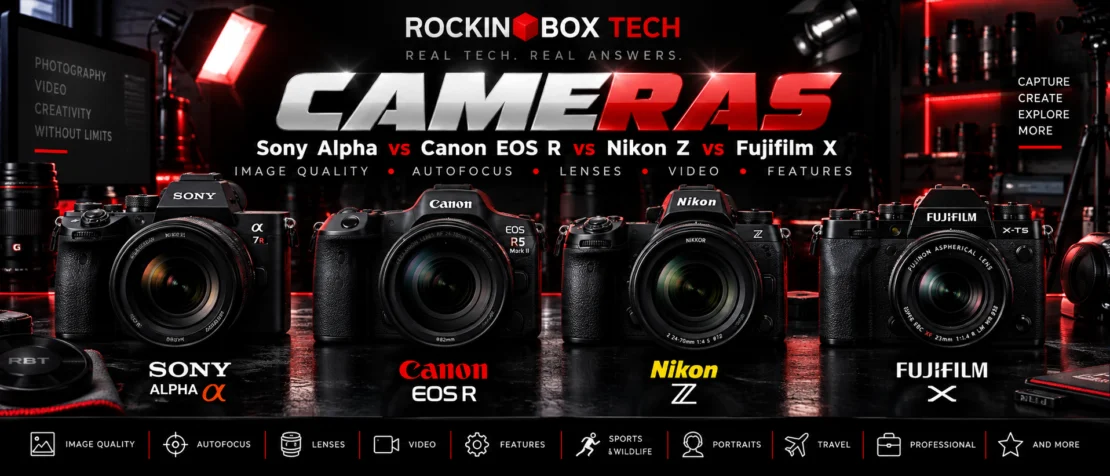
QUICK VERDICT
Sony Alpha
An exceptionally complete mirrorless ecosystem with class-leading autofocus capabilities, strong hybrid video tools and one of the broadest lens selections available.
Canon EOS R
A polished camera system with excellent autofocus, strong ergonomics, superb RF lenses and impressive still-photo and video performance.
Nikon Z
Outstanding image quality, excellent handling and a rapidly developed Z-mount system make Nikon especially compelling for serious photographers.
Fujifilm X
A distinctive APS-C ecosystem combining compact bodies, excellent lenses, traditional controls and Fujifilm's popular color and Film Simulation experience.
TYPICAL BODY PRICE RANGE
Sony Alpha
APS-C creator cameras through flagship professional full-frame Alpha bodies.
Body-only pricing varies by model, promotions and generation.
Canon EOS R
Entry APS-C EOS R bodies through professional full-frame cameras such as the EOS R1.
Lenses and kits can significantly change total system cost.
Nikon Z
Entry Z-series bodies through advanced full-frame cameras such as the Z8 and flagship Z9.
Current promotions can reduce prices substantially.
Fujifilm X
Compact and enthusiast APS-C bodies through higher-performance X-series hybrid cameras.
This comparison covers Fujifilm X, not the larger GFX medium-format system.
SIDE-BY-SIDE COMPARISON
| Feature | Sony Alpha | Canon EOS R | Nikon Z | Fujifilm X |
|---|---|---|---|---|
| Primary Formats | APS-C & full-frame | APS-C & full-frame | APS-C DX & full-frame FX | APS-C |
| Image Quality | Outstanding | Outstanding | Outstanding | Excellent to outstanding |
| Autofocus | Outstanding | Outstanding | Excellent to outstanding | Very good to excellent |
| Subject Detection | Excellent across recent models | Excellent Dual Pixel CMOS AF implementation | Excellent on newer Z bodies | Strong on newer X bodies |
| Native Lens Ecosystem | Outstanding | Excellent | Excellent and expanding | Excellent APS-C selection |
| Third-Party Lenses | Outstanding | Growing | Growing | Strong |
| Video | Outstanding | Outstanding | Outstanding on higher-end bodies | Excellent to outstanding |
| In-Body Stabilization | Available on many models | Available on many mid/high-end models | Available on many full-frame models | Available on several higher-end models |
| Sports & Wildlife | Outstanding | Outstanding | Outstanding | Excellent, especially X-H2S |
| Portraits | Outstanding | Outstanding | Outstanding | Excellent |
| Travel | Excellent | Excellent | Excellent | Outstanding |
| Traditional Controls | Modern control layout | Modern control layout | Excellent ergonomics | Outstanding tactile controls on many models |
| Professional Upgrade Path | Outstanding | Outstanding | Outstanding | Strong within APS-C |
| Best Strength | AF, video & system depth | Balanced hybrid performance | Stills, handling & optics | Travel, color & photography experience |
WHAT EACH SYSTEM DOES BEST
Sony Alpha
Autofocus, hybrid shooting and system choice.
Sony's E-mount ecosystem covers compact APS-C cameras, mainstream full-frame hybrids, high-resolution bodies, video-focused cameras and professional sports models.
Canon EOS R
Balanced performance and intuitive operation.
Canon combines excellent Dual Pixel autofocus, attractive RF optics, strong color and usability with cameras ranging from beginner models to professional flagships.
Nikon Z
Photography, ergonomics and premium optics.
Nikon's Z system is especially compelling for photographers who value handling, image quality and high-end lenses while still offering excellent modern video capabilities.
Fujifilm X
Compact photography and creative shooting.
Fujifilm's APS-C strategy allows smaller bodies and lenses while its Film Simulations and physical controls give the X system a distinctive photography-first personality.
PROS & CONS
Sony Alpha
- Excellent autofocus
- Strong subject detection
- Outstanding video options
- Huge E-mount lens selection
- Excellent third-party lens support
- Wide range of specialized bodies
- Menus and controls can feel complex
- Premium bodies and lenses get expensive
- Many overlapping camera choices can confuse beginners
Canon EOS R
- Excellent Dual Pixel autofocus
- Strong subject detection
- Excellent ergonomics
- High-quality RF lenses
- Strong photo/video balance
- EF lens adaptation available
- Some premium RF lenses are expensive
- Third-party RF autofocus lens options remain less extensive than Sony E-mount
- Features vary widely by EOS R model
Nikon Z
- Excellent image quality
- Excellent ergonomics
- Strong professional bodies
- High-quality NIKKOR Z lenses
- Strong sports and wildlife options
- F-mount lenses adaptable with FTZ
- Some high-end lenses are very expensive
- Older Z bodies can trail newer models in AF sophistication
- Third-party lens selection is still developing
Fujifilm X
- Compact APS-C system
- Excellent Film Simulations
- Outstanding tactile controls
- Excellent travel and street cameras
- Strong native XF lens range
- Good photo/video hybrid options
- No full-frame upgrade path within X Series
- Autofocus can trail the best Sony/Canon implementations
- Premium X bodies can approach full-frame pricing
WHO SHOULD CHOOSE WHICH?
Choose Sony Alpha If...
You want outstanding autofocus, serious video capability, a huge lens ecosystem and the widest range of mirrorless body specialties.
Choose Canon EOS R If...
You want excellent autofocus, intuitive handling, strong hybrid performance and access to Canon's RF lens ecosystem.
Choose Nikon Z If...
You prioritize still photography, comfortable ergonomics, premium optics, sports or wildlife capability and a strong professional upgrade path.
Choose Fujifilm X If...
You value smaller APS-C equipment, travel and street photography, physical controls, distinctive color rendering and a photography-focused experience.
BEST CAMERA SYSTEM BY USE
RBT VERDICT
Overall Edge: Sony Alpha — But Lens Choice and Shooting Style Matter More Than the Logo.
Sony Alpha receives our narrow overall edge because its combination of sophisticated autofocus, strong video performance, extensive E-mount lens availability and unusually broad range of camera bodies makes it difficult to outgrow.
Canon EOS R is extremely close. Canon combines excellent Dual Pixel autofocus, strong ergonomics, impressive RF lenses and a balanced still/video experience that makes EOS R one of the easiest systems to recommend to a broad range of photographers.
Nikon Z is especially compelling for photographers who prioritize image quality, handling, professional lenses and still-photo performance. Models such as the Z8 and Z9 have also established Nikon as a serious high-speed hybrid and professional mirrorless platform.
Fujifilm X takes a different approach. Instead of competing directly in full-frame, Fujifilm has built a deep APS-C ecosystem that emphasizes portability, tactile controls, lenses designed specifically for the format and a distinctive creative photography experience.
The most important decision is often the lens system rather than the camera body. Bodies are replaced every few years; good lenses may remain in a photographer's kit for decades. Before choosing a system, identify the lenses you will realistically need for portraits, wildlife, sports, travel, video or professional work and compare the complete cost of that kit.