
ASUS Xonar AE 7.1 PCIe Gaming Sound Card Review
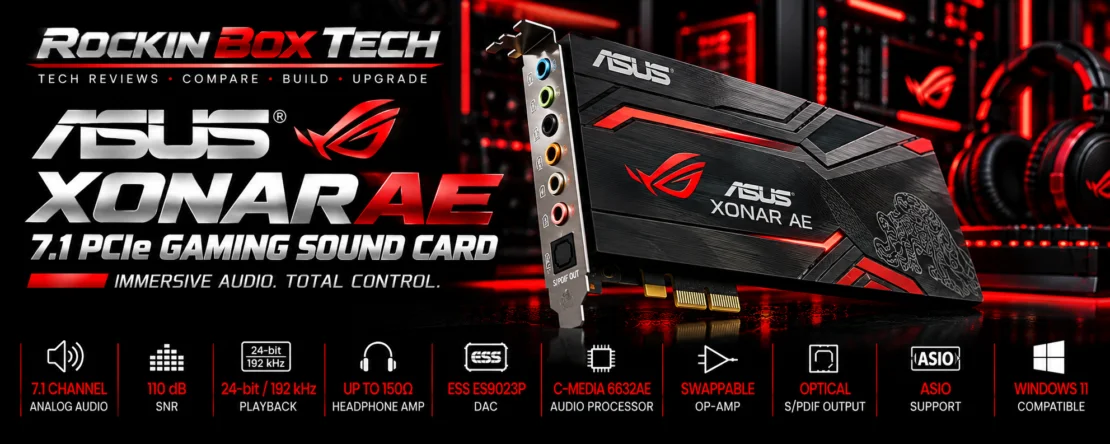
A 7.1-channel internal PCIe sound card combining an ESS DAC, 24-bit / 192 kHz playback, a 150Ω headphone amplifier, optical digital output and swappable op-amp customization.
What It Is
The ASUS Xonar AE is an internal PCI Express sound card aimed at gaming, entertainment and desktop users who want more connectivity and customization than a basic motherboard audio implementation.
Unlike the more entry-level Xonar SE, the Xonar AE provides 7.1-channel analog output and combines a C-Media 6632AE audio processor with an ESS ES9023P DAC. ASUS specifies playback up to 24-bit / 192 kHz and a signal-to-noise ratio of 110 dB.
It also includes a dedicated headphone amplifier rated for headphones up to 150Ω, optical digital output and a swappable operational amplifier for users interested in changing part of the card's analog output characteristics.
Key Specifications
| Model | ASUS Xonar AE |
|---|---|
| Interface | Internal PCI Express |
| Audio Channels | Up to 7.1-channel analog output |
| Audio Processor | C-Media 6632AE |
| D-A Converter | ESS ES9023P |
| Maximum Playback | Up to 24-bit / 192 kHz |
| Signal-to-Noise Ratio | 110 dB |
| Headphone Amplifier | Designed for headphones up to 150Ω |
| Analog Output | Up to 7.1 channels |
| Digital Output | Optical TOSLINK S/PDIF output |
| Microphone / Line Input | 3.5 mm input |
| Front-Panel Audio | Supported through internal header |
| Op-Amp | Swappable operational amplifier |
| ASIO | Supported |
| Current Windows Support | Windows 11 64-bit driver available from ASUS |
ESS ES9023P DAC
The Xonar AE uses an ESS ES9023P digital-to-analog converter. This distinguishes it from the less expensive Xonar SE and gives the AE a different internal audio architecture.
ESS Conversion
The ES9023P handles digital-to-analog conversion for the card and is paired with ASUS's surrounding analog circuitry.
110 dB SNR
ASUS specifies a 110 dB signal-to-noise ratio for the Xonar AE, providing substantial range for gaming, music and multimedia.
24-bit / 192 kHz
Playback support up to 24-bit / 192 kHz covers common high-resolution audio material without requiring extreme sample-rate specifications.
7.1-Channel Analog Audio
One of the Xonar AE's major advantages over the Xonar SE is its support for up to 7.1-channel analog output.
True Multichannel Connectivity
The card can connect directly to compatible multichannel analog speaker systems rather than relying exclusively on HDMI or digital audio routing.
Gaming & Entertainment
A 7.1 analog layout can be useful for desktop gaming, movies and existing speaker systems built around multiple analog connections.
150Ω Headphone Amplifier
ASUS equips the Xonar AE with a dedicated headphone amplifier designed for headphones with impedance ratings up to 150Ω.
Dedicated Amplification
The amplifier provides a dedicated headphone-driving stage rather than depending entirely on a basic motherboard headphone output.
Gaming Headsets & Headphones
Its output capability covers many commonly used wired gaming headsets and consumer headphones.
Swappable Op-Amp
One of the more enthusiast-oriented features of the Xonar AE is its swappable operational amplifier.
This allows technically inclined users to replace the compatible op-amp rather than being permanently limited to the factory component.
Optical S/PDIF Output
The Xonar AE includes optical TOSLINK S/PDIF output for compatible receivers, DACs and digital speaker systems.
Digital Connection
Optical output provides electrical isolation between the PC and compatible external audio hardware.
Flexible Desktop Audio
Users can retain analog multichannel outputs while also having a digital connection available for other audio equipment.
Current Windows Compatibility
Driver support is now a required part of the Rockin Box Tech selection process for internal sound cards. A historically good card is not useful for this review category if it cannot reasonably operate in a current PC.
Windows 11
ASUS's current support system provides a Windows 11 64-bit operating-system selection and driver download for the Xonar AE.
Windows 10
Windows 10 driver support is also available from ASUS, covering another major generation of modern desktop systems.
Windows 8.1
ASUS also provides support options for Windows 8.1, satisfying the minimum operating-system generation established for this Rockin Box Tech category.
Sonic Studio
ASUS pairs the Xonar AE with its Sonic Studio software for controlling audio functions and effects from Windows.
Audio Configuration
Software controls allow users to manage speaker, headphone and audio-processing settings from the desktop.
Gaming Features
The software environment includes gaming-oriented audio controls for users who prefer processed rather than purely direct audio.
Customization
Equalization and effect controls allow the presentation to be adjusted for different headphones, speakers and content.
Xonar AE vs Xonar SE
Although both are ASUS internal PCIe sound cards, they fill different positions in this Rockin Box Tech lineup.
Xonar AE
Provides 7.1 analog capability, an ESS ES9023P DAC, swappable op-amp, 110 dB SNR and headphone amplification rated for headphones up to 150Ω.
Xonar SE
Provides a simpler 5.1 configuration, 116 dB SNR and headphone amplification rated for headphones up to 300Ω, making it the more straightforward value-oriented option.
What Owners Are Saying
Available exact-model consumer feedback is generally positive, but the review pool is smaller than the very large samples available for mainstream PC components such as graphics cards and SSDs.
Audio Quality
Positive feedback commonly centers on sound quality and the improvement users perceive when replacing weaker onboard audio implementations.
Useful Feature Set
Multichannel output, headphone amplification and optical connectivity give the card practical appeal for users with existing wired audio equipment.
Software Matters
As with other internal sound cards, drivers and control software remain part of the ownership experience. Hardware quality alone does not determine how smoothly a card behaves on every Windows PC.
Where the Xonar AE Still Makes Sense
7.1 Analog Systems
The card is especially relevant for users who still operate multichannel analog speaker systems and need more than 5.1.
Wired Headphones
Its dedicated amplifier provides an alternative to basic motherboard headphone outputs.
Optical Equipment
TOSLINK output supports connection to compatible external receivers, DACs and speaker systems.
Gaming PCs
Multichannel audio and ASUS software features make gaming one of the card's primary intended applications.
Op-Amp Experimentation
Enthusiasts interested in compatible op-amp changes receive a level of hardware customization uncommon on basic cards.
Current Windows Desktops
Official Windows 11 driver availability keeps the card relevant to present-day PC builds.
Strengths & Limitations
Strengths
- True internal PCIe sound card
- Official Windows 11 64-bit driver available
- Windows 10 and Windows 8.1 support
- Up to 7.1-channel analog audio
- ESS ES9023P DAC
- C-Media 6632AE audio processor
- Up to 24-bit / 192 kHz playback
- 110 dB signal-to-noise ratio
- Dedicated headphone amplifier
- Designed for headphones up to 150Ω
- Optical TOSLINK S/PDIF output
- Swappable op-amp
- ASIO support
- Front-panel audio connectivity
- Useful alternative to Creative's internal cards
Limitations
- Requires an available internal PCIe slot
- 110 dB SNR is lower than the Xonar SE's published 116 dB
- 150Ω headphone rating is lower than some competing cards
- No external desktop control module
- Software and driver behavior remain part of the ownership experience
- Optical S/PDIF has format and bandwidth limitations
- Swapping op-amps does not guarantee audible improvement
- Modern premium motherboard audio may already satisfy some users
- Exact-model consumer review samples are relatively limited
Works Best With
7.1 Analog Speakers
One of the more useful applications is a desktop system that still relies on direct multichannel analog connections.
Gaming Headphones
Wired headphones and gaming headsets can take advantage of the card's dedicated headphone amplification and software controls.
Modern Windows PCs
Current Windows 11 driver availability makes the Xonar AE appropriate for present-day desktop systems with an available PCIe expansion slot.
Rockin Box Tech Summary
The ASUS Xonar AE gives this internal sound-card lineup a more feature-oriented ASUS option than the simpler Xonar SE.
Its biggest practical distinction is 7.1-channel analog output. Users with multichannel analog speaker systems can connect directly to the card without relying entirely on HDMI or an external USB audio device.
The ESS ES9023P DAC, 24-bit / 192 kHz capability, 110 dB SNR and dedicated 150Ω headphone amplifier provide a solid technical foundation, while optical output and ASIO support broaden its usefulness beyond gaming alone.
The swappable op-amp adds an enthusiast feature rarely found on entry-level cards. It should be viewed as an opportunity for experimentation rather than a guaranteed path to better sound.
Most importantly for a review being published now, ASUS currently supplies Windows 11 64-bit driver support for the Xonar AE. That allows it to remain useful in a modern desktop rather than being treated merely as interesting legacy hardware.
The Xonar AE therefore earns its place because it combines current Windows compatibility with 7.1 analog connectivity, headphone amplification, optical output and hardware customization. It offers a meaningfully different configuration from both the Xonar SE and the three Creative cards already reviewed.
Research Disclosure: Rockin Box Tech reviews are research-driven. Technical information is compiled from current manufacturer specifications, official driver and support pages, documentation, independent information and available consumer feedback. Rockin Box Tech does not represent that this product was physically tested unless explicitly stated. Manufacturer specifications are treated as technical claims, while owner and community comments are treated as anecdotal consumer experience rather than controlled testing. Drivers, software, compatibility, pricing and availability may change over time.