
AMD Ryzen 7 9800X3D
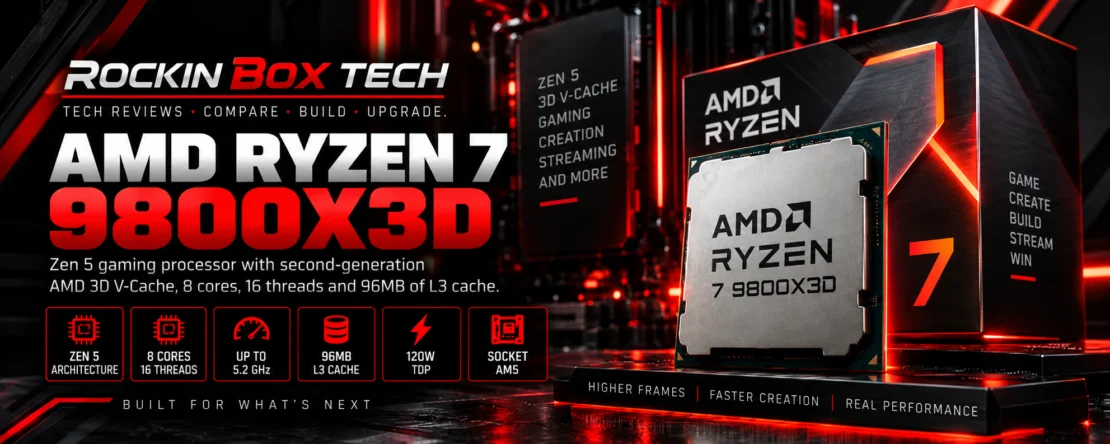
Zen 5 gaming processor with second-generation AMD 3D V-Cache, 8 cores, 16 threads and 96MB of L3 cache.
Quick Product Overview
The AMD Ryzen 7 9800X3D is an enthusiast desktop processor designed primarily around high-end gaming performance. It combines AMD's Zen 5 architecture with second-generation 3D V-Cache technology, providing 96MB of L3 cache while retaining eight CPU cores and sixteen processing threads.
AMD launched the processor on November 7, 2024. Its 4.7 GHz base clock, boost frequency of up to 5.2 GHz and redesigned cache arrangement helped remove several limitations associated with earlier X3D processors, including allowing the chip to be officially unlocked for overclocking.
Key Specifications
| Processor | AMD Ryzen 7 9800X3D |
|---|---|
| Architecture | Zen 5 |
| Codename | Granite Ridge AM5 |
| Cores / Threads | 8 cores / 16 threads |
| Base Clock | 4.7 GHz |
| Maximum Boost Clock | Up to 5.2 GHz |
| L1 Cache | 640 KB |
| L2 Cache | 8 MB |
| L3 Cache | 96 MB |
| Total Cache | 104 MB combined L1 + L2 + L3 |
| Default TDP | 120W |
| CPU Process | TSMC 4nm FinFET |
| I/O Die Process | TSMC 6nm FinFET |
| Socket | AM5 |
| PCI Express | PCIe 5.0 |
| Native PCIe Lanes | 28 total / 24 usable |
| Memory Type | DDR5, dual-channel |
| Official Memory Speed | Up to DDR5-5600 with supported two-DIMM configurations |
| Maximum Memory | 256 GB |
| ECC Support | Yes, when supported by the motherboard |
| Integrated Graphics | AMD Radeon Graphics, 2 graphics cores, 2200 MHz |
| Overclocking | Unlocked |
| Maximum Operating Temperature | 95°C Tjmax |
| Cooler Included | No |
| Launch Date | November 7, 2024 |
Performance & Use-Case Information
High-End Gaming
The 9800X3D's large 3D V-Cache is particularly beneficial in games that respond strongly to additional CPU cache and reduced memory latency. Independent launch testing consistently placed it at or near the top of gaming CPU charts of its generation.
High-Refresh-Rate Gaming
The processor is especially relevant for systems targeting very high frame rates where the CPU is more likely to become the limiting component, such as competitive gaming at 1080p or 1440p with a powerful graphics card.
Everyday Productivity
Eight Zen 5 cores and sixteen threads provide strong general desktop performance for office work, browsing, multitasking and typical productivity applications.
Content Creation
It is capable in photo editing, video work and creative applications, but users whose primary workload is heavily threaded production may benefit from processors with more CPU cores.
Heavy Rendering
Long-duration CPU rendering and similarly parallel workloads are not the 9800X3D's primary design target. Higher-core-count Ryzen 9 or competing workstation-oriented processors can provide more throughput.
Mixed Workloads
For users who game heavily but also perform regular desktop and creator work, the 9800X3D offers a more balanced combination than some earlier gaming-specialized X3D processors.
Power Efficiency & Thermals
AMD specifies a 120W default TDP and a maximum operating temperature of 95°C. The processor does not include a boxed CPU cooler.
AMD specifically recommends a liquid cooler for optimal performance. A high-quality cooling solution gives Precision Boost additional thermal headroom and is particularly appropriate for sustained gaming, productivity workloads or manual tuning.
Independent reviewers generally found the 9800X3D's gaming performance impressive relative to its power requirements. Actual system consumption should not be confused with AMD's TDP rating, because measured package and wall power vary substantially by workload and platform.
Platform & Compatibility
AM5 Motherboards
AMD lists support for A620, B650, B650E, X670, X670E, B840, B850, X870 and X870E chipsets. Compatibility can depend on motherboard BIOS revision, particularly with boards released before Ryzen 9000.
DDR5 Memory
The processor uses DDR5 memory only. AMD's official memory specification reaches DDR5-5600 in supported two-module configurations, while faster EXPO memory settings are overclocked profiles and depend on the CPU, motherboard, BIOS and memory kit.
PCIe 5.0
The processor provides PCI Express 5.0 connectivity with 28 native lanes, 24 of which AMD lists as usable. Actual slot and M.2 configuration is determined by the motherboard.
Existing AM5 Owners
One advantage of the 9800X3D is that it remains on AMD's AM5 platform. Owners of a compatible AM5 motherboard may be able to upgrade without replacing the board or memory, although BIOS support should always be verified first.
Works Best With
These are examples of well-matched components, not mandatory purchases. Exact compatibility should always be checked against the motherboard's CPU support list, memory QVL, case dimensions and cooler specifications before buying.
MSI MAG X870 TOMAHAWK WIFI
An X870 AM5 motherboard officially supporting Ryzen 9000 desktop processors, DDR5 memory and PCIe 5.0. It provides a modern platform for a high-performance 9800X3D build.
G.SKILL Trident Z5 Neo DDR5-6000
AMD EXPO-capable DDR5-6000 kits provide a popular high-performance pairing for AM5 systems. DDR5-6000 is an overclocked memory setting, so the exact kit should be checked against the motherboard QVL.
ARCTIC Liquid Freezer III 360
A 360mm all-in-one liquid cooler with official AM5 compatibility. It fits AMD's recommendation to use liquid cooling for optimal 9800X3D performance, provided the computer case supports the radiator.
Integrated Radeon Graphics
The Ryzen 7 9800X3D includes basic AMD Radeon Graphics with two graphics cores operating at up to 2200 MHz. This integrated GPU can be useful for basic display output, troubleshooting or systems that temporarily operate without a discrete graphics card.
It should not be considered a replacement for a dedicated gaming GPU in the type of high-performance gaming system for which the 9800X3D is normally purchased.
What Independent Reviewers Found
GamersNexus
GamersNexus found the 9800X3D exceptionally strong in gaming and described it as the new gaming leader at launch. Their testing also emphasized that heavily threaded production workloads are not the processor's strongest area.
Tom's Hardware
Tom's Hardware found major gaming advantages over contemporary Intel processors while also noting improved productivity performance compared with earlier X3D chips. Their review also praised efficiency and cooling behavior.
TechSpot
TechSpot's launch coverage strongly recommended the processor for gaming, while later testing placed its generational improvement over the 7800X3D in a more measured context. That makes price an important part of the buying decision.
Where Reviewers Agree — And Disagree
Where They Generally Agree
- Gaming performance is the 9800X3D's primary strength.
- The second-generation 3D V-Cache design improves on earlier X3D implementations.
- Eight Zen 5 cores remain sufficient for high-end gaming systems.
- Productivity performance is improved compared with previous gaming-focused X3D designs.
- It is a strong match for powerful discrete graphics cards and high-refresh-rate gaming.
Where Context Matters
- The performance benefit varies significantly from game to game.
- GPU-limited gaming at higher resolutions can reduce visible CPU differences.
- Higher-core-count processors remain stronger choices for some production workloads.
- Its value depends heavily on current pricing relative to the 7800X3D, 9850X3D and other alternatives.
Strengths & Limitations
Strengths
- Exceptional gaming-oriented CPU performance
- 96MB L3 cache using second-generation 3D V-Cache
- Strong single-threaded Zen 5 performance
- Improved productivity capability compared with earlier X3D designs
- Unlocked for processor tuning and overclocking
- AM5 platform provides broad motherboard compatibility
- PCIe 5.0 and DDR5 support
- Basic integrated Radeon graphics included
Limitations
- Premium pricing can reduce value when alternatives are heavily discounted
- Only eight CPU cores for users focused primarily on highly parallel workloads
- No boxed cooler is included
- AMD recommends liquid cooling for optimal performance
- Requires DDR5 memory
- Gaming gains can shrink when performance is limited by the graphics card
Upgrade Considerations
From Ryzen 7 7800X3D
The 9800X3D is faster and removes some of the earlier X3D design limitations, but owners of a 7800X3D should compare real performance gains against upgrade cost before replacing an already capable gaming processor.
From Standard Ryzen 7000
Gamers on compatible AM5 systems can potentially gain substantial gaming performance in CPU-sensitive titles while retaining their motherboard and DDR5 memory, subject to BIOS compatibility.
From Older Platforms
Moving from AM4 or an older Intel platform generally requires a new motherboard and DDR5 memory in addition to the processor, so total platform cost should be considered rather than CPU price alone.
Alternatives to Consider
AMD Ryzen 7 9850X3D
AMD's newer 2026 eight-core X3D processor increases maximum boost clock to 5.6 GHz while retaining 96MB L3 cache and a 120W TDP. Buyers seeking AMD's newer top gaming option should compare its price directly with the 9800X3D.
AMD Ryzen 7 7800X3D
The previous-generation X3D gaming processor remains relevant when discounted substantially below the 9800X3D. It can still deliver very strong gaming performance on the AM5 platform.
Higher-Core-Count CPUs
Users who spend more time rendering, encoding or running heavily threaded professional applications may benefit more from higher-core Ryzen 9 or competing processors than from the gaming-focused 9800X3D.
Who Is It Best For?
Enthusiast Gamers
Users building a high-performance gaming PC with a powerful discrete graphics card and looking to minimize CPU bottlenecks.
High-Refresh Players
Competitive and performance-focused players targeting very high frame rates, particularly where CPU performance matters more than resolution.
Gaming-First AM5 Upgrades
Existing AM5 owners who want a substantial gaming-focused processor upgrade while potentially retaining their motherboard and DDR5 memory.
Rockin Box Tech Research Summary
Research from AMD's technical specifications and multiple independent reviewers places the Ryzen 7 9800X3D firmly in the high-end gaming category. Its combination of Zen 5 cores and 96MB of L3 cache gives it a major advantage in workloads and games that respond well to AMD's 3D V-Cache technology.
The processor is more versatile than earlier X3D designs because its productivity performance, clocks and tuning flexibility have improved. It is still primarily a gaming-focused choice rather than the automatic best processor for every type of workload.
In 2026, the purchasing decision also depends on price. AMD's newer Ryzen 7 9850X3D now occupies the higher gaming position in the product family, while discounted 7800X3D processors can sometimes offer strong value. The 9800X3D remains especially attractive when its price sits meaningfully below the newer model.