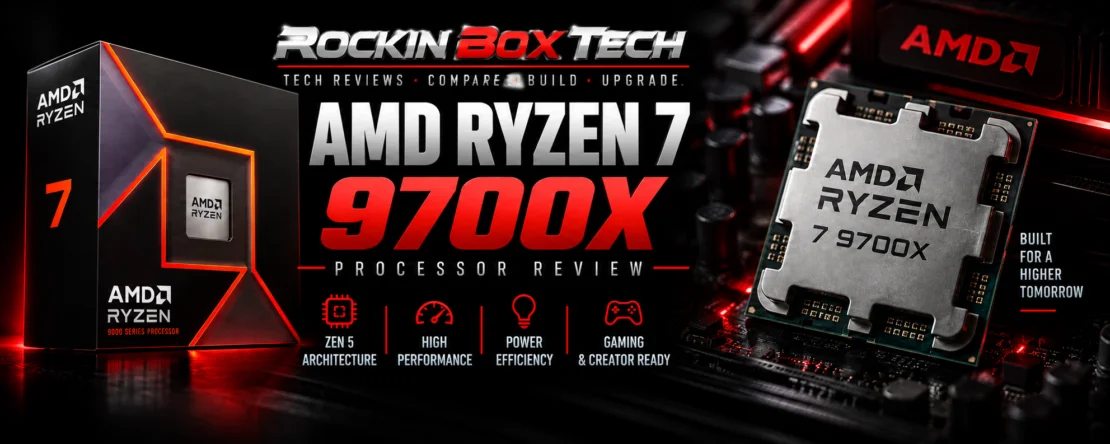
ROCKIN BOX TECH • RESEARCH-DRIVEN REVIEW
AMD Ryzen 7 9700X
AMD's Ryzen 7 9700X is an eight-core, sixteen-thread Zen 5 desktop
processor positioned as a high-performance AM5 all-rounder. Its story
is not simply about benchmark leadership: efficiency, platform
longevity, productivity performance, gaming competition and the
availability of AMD's X3D processors all affect whether the 9700X
makes sense for a particular PC.
ZEN 5
8 CORES / 16 THREADS
UP TO 5.5 GHz
65W TDP
SOCKET AM5
DDR5
PCIe 5.0
PRODUCT OVERVIEW
The Ryzen 7 9700X belongs to AMD's Ryzen 9000 desktop family and uses
the Zen 5 architecture. It retains the familiar eight-core,
sixteen-thread configuration of the previous-generation Ryzen 7
7700X while moving the CPU cores to a newer architecture and operating
at a substantially lower default TDP.
That makes the 9700X particularly interesting as a balanced processor.
It has enough cores for gaming, everyday computing, streaming and
substantial productivity workloads without moving into the higher
core counts, power requirements and prices associated with Ryzen 9.
THE IMPORTANT CONTEXT
The 9700X should not be judged only by how much faster it is than the
7700X. Independent testing showed that its generational performance
gains can be modest in some workloads, while its power efficiency is
one of its strongest characteristics.
KEY SPECIFICATIONS
Architecture
AMD Zen 5
Codename
Granite Ridge
CPU Cores
8
Threads
16
Base Clock
3.8 GHz
Maximum Boost
Up to 5.5 GHz
L1 Cache
640 KB
L2 Cache
8 MB
L3 Cache
32 MB
Default TDP
65W
CPU Process
TSMC 4nm FinFET
I/O Die Process
TSMC 6nm FinFET
Socket
AM5
Memory
DDR5 Dual Channel
PCI Express
PCIe 5.0
Overclocking
Unlocked
Integrated Graphics
AMD Radeon Graphics
Box Cooler
Not Included
ZEN 5 ARCHITECTURE & TECHNOLOGY
Zen 5 is the architectural foundation of Ryzen 9000. AMD revised
important parts of the execution engine, front end and data paths
while retaining the AM5 desktop platform. The 9700X combines one
eight-core CPU chiplet with a separate I/O die.
Eight Zen 5 Cores
Eight physical cores with simultaneous multithreading provide
sixteen processing threads, giving the processor a useful
balance between lightly threaded responsiveness and
multithreaded capability.
Precision Boost
AMD's automatic boost technology dynamically adjusts operating
frequency according to workload, temperature, electrical and
power conditions rather than holding the CPU at one fixed
clock speed.
Overclocking Support
The processor is unlocked and supports AMD tuning technologies
including Precision Boost Overdrive, Curve Optimizer and
Ryzen Master.
Modern AM5 Platform
DDR5 memory and PCIe 5.0 support place the processor on AMD's
current desktop platform rather than the older AM4 ecosystem.
GAMING PERFORMANCE
The Ryzen 7 9700X is a capable gaming processor, but gaming is also
where its position becomes complicated. CPU gaming results vary with
the graphics card, resolution, game engine, memory configuration,
operating system and test methodology.
TechSpot's launch testing across 13 games found the 9700X only about
three percent faster on average than the Ryzen 7 7700X. Individual
games varied: some showed small improvements, some were essentially
unchanged, and at least one of its tested titles placed the 9700X
behind the older processor.
PC Gamer reached a more positive overall gaming conclusion within its
own test suite, finding the 9700X competitive across the tested CPUs.
These differing results illustrate why a single benchmark or single
publication should not be treated as the complete picture.
GAMING TAKEAWAY
The 9700X has ample gaming capability, but buyers focused almost
exclusively on maximizing frame rates should also compare AMD's X3D
processors. 3D V-Cache models are specifically optimized for workloads
that benefit from substantially larger cache and can occupy a
different position in gaming benchmarks.
PRODUCTIVITY & CREATOR WORKLOADS
Eight Zen 5 cores and sixteen threads make the 9700X more than a
gaming-only processor. It is suitable for mixed-use systems handling
office applications, software development, image work, encoding,
streaming and a variety of content-creation workloads.
PC Gamer reported particularly strong results from the processor in
its productivity and content-creation testing and highlighted photo
editing as an especially favorable workload. Results naturally vary
by application: workloads that scale strongly across many CPU cores
can favor processors with twelve, sixteen or more cores.
Everyday Productivity
Strong single-threaded performance and eight modern cores make
the 9700X well suited to general-purpose high-performance PCs.
Content Creation
Photo editing, encoding and moderately threaded creative
workloads can benefit from Zen 5's performance without
requiring a high-power enthusiast CPU.
Heavy Rendering
Users whose work scales efficiently across many CPU cores
should compare Ryzen 9 and other higher-core-count processors
before choosing an eight-core model.
Mixed Workloads
The combination of gaming ability, sixteen processing threads
and relatively restrained power consumption is one of the
9700X's most compelling characteristics.
POWER EFFICIENCY & THERMALS
Efficiency is one of the clearest strengths identified in independent
testing. AMD specifies a 65W default TDP, substantially below the
105W default TDP of the Ryzen 7 7700X.
GamersNexus measured approximately 88W at the EPS12V cables during its
all-core Blender power test and found the 9700X leading its tested
chart for all-core energy efficiency at the time of that review.
This was a major part of its otherwise critical assessment of the
processor.
PC Gamer also praised power efficiency and reported manageable
temperatures during its testing, including with a comparatively
inexpensive dual-fan air cooler. Exact temperatures will always
depend on cooler, motherboard settings, case airflow, ambient
temperature and workload.
PLATFORM & COMPATIBILITY
Socket AM5
The 9700X uses AMD's AM5 socket. Motherboard compatibility
depends on chipset and BIOS support, so builders should verify
the motherboard manufacturer's CPU-support list and BIOS
requirements before installation.
DDR5 Memory
AM5 uses DDR5 rather than DDR4. Buyers moving from older
platforms may therefore need new memory in addition to the
processor and motherboard.
PCIe 5.0
The platform supports PCI Express 5.0, although the exact
expansion and storage configuration available depends on the
motherboard and chipset.
Cooling
AMD does not include a thermal solution with the boxed 9700X.
A compatible AM5 cooling solution is therefore required.
WORKS BEST WITH
A processor is only one part of a complete system. For the Ryzen 7
9700X, these component pairings provide a strong starting point for
an AM5 build focused on performance, compatibility, cooling and
long-term usability. These are examples of well-matched components
rather than mandatory purchases.
Motherboard
MSI MAG X870 TOMAHAWK WIFI
A feature-rich AM5 motherboard that supports Ryzen 9000
processors. The X870 platform provides a modern foundation
for a 9700X system with DDR5 memory, PCIe expansion,
high-speed storage and current connectivity.
- Socket AM5
- AMD X870 chipset
- Ryzen 9000 support
- Four DDR5 DIMM slots
- Modern expansion and storage support
WHY IT FITS:
A current AM5 motherboard gives the 9700X the platform
features expected from a higher-performance Ryzen 9000
system.
Memory
G.SKILL Trident Z5 Neo DDR5-6000
Trident Z5 Neo memory is designed for AMD's DDR5-enabled
AM5 platform and supports AMD EXPO profiles. A matched
two-module kit provides a straightforward dual-channel
configuration for a performance-oriented Ryzen build.
- DDR5 memory
- Designed for AMD AM5
- AMD EXPO profile support
- DDR5-6000 kits available
- Matched dual-channel configurations
IMPORTANT:
DDR5-6000 operation is an overclocked memory profile rather
than AMD's base JEDEC specification. Verify the exact kit
against the motherboard memory-support list.
CPU Cooler
Noctua NH-D15 G2 LBC
A large premium air cooler designed to provide substantial
thermal headroom for modern desktop processors. Its LBC
base geometry is intended for relatively flat CPU heat
spreaders such as those used on AMD AM5.
- AM5 compatible
- AM5-oriented base geometry
- Dual-tower heatsink
- Large dual-fan configuration
- High cooling capability
CHECK CLEARANCE:
Large tower coolers require adequate case height and can
interact with tall memory modules. Verify dimensions
before purchasing.
Why These Components Pair Well
Together, these components address three of the most important
parts of a Ryzen 7 9700X build: a current AM5 motherboard platform,
performance-oriented DDR5 memory with AMD EXPO support, and a
cooling solution with substantial thermal headroom. They are not
the only compatible choices, and less expensive alternatives may
be completely appropriate depending on the system.
COMPATIBILITY NOTE:
Hardware compatibility can vary by BIOS revision, memory kit,
motherboard, cooler mounting hardware, RAM height and PC case
dimensions. Always verify current manufacturer compatibility
information before purchasing.
INTEGRATED RADEON GRAPHICS
The Ryzen 7 9700X includes integrated AMD Radeon Graphics. This is
useful for display output, system setup, troubleshooting and systems
that do not require a powerful discrete GPU.
It should not, however, be confused with AMD's more graphics-focused
desktop APUs. A gaming or GPU-intensive workstation built around the
9700X will normally be paired with a discrete graphics card.
WHAT INDEPENDENT REVIEWERS FOUND
GamersNexus
GamersNexus was notably critical of the generational performance
improvement and characterized the launch as a missed opportunity.
Its strongest praise centered on efficiency, where the 9700X
performed exceptionally well in its testing.
Read the GamersNexus testing →
TechSpot
TechSpot's launch assessment was also critical of the small
performance improvement over the Ryzen 7 7700X. Its 13-game
average placed the 9700X only around three percent ahead of the
7700X, making launch value a central concern.
Read the TechSpot review →
PC Gamer
PC Gamer was more enthusiastic. It regarded the processor as a
fast and power-efficient all-rounder, praised its broad
performance and efficiency, but still suggested that enthusiasts
primarily interested in gaming should consider X3D alternatives.
Read the PC Gamer review →
Tom's Hardware
Tom's Hardware coverage of Ryzen 9000 highlighted gaming
performance, single-threaded capability, efficiency and low power
consumption while also documenting the evolving software and
platform environment surrounding early Zen 5 testing.
Visit Tom's Hardware CPU coverage →
WHERE REVIEWERS AGREE — AND DISAGREE
The clearest area of agreement is efficiency.
Independent reviewers repeatedly identified the 9700X's relatively
low power consumption as a major strength.
The disagreement is primarily about
how much the performance improvement matters.
Some test suites produced a favorable overall picture, while others
showed only small gains over Zen 4, especially in gaming.
Differences in applications, games, BIOS revisions, Windows behavior,
memory settings and test methodology can all contribute to different
benchmark results.
This is why Rockin Box Tech does not reduce a research review to one
benchmark chart or one publication's verdict.
STRENGTHS & LIMITATIONS
STRENGTHS
- Strong all-around eight-core / sixteen-thread performance
- Excellent power efficiency in independent testing
- Relatively modest 65W default TDP
- Zen 5 architecture
- AM5 platform compatibility
- DDR5 and PCIe 5.0 support
- Unlocked multiplier and AMD tuning support
- Integrated graphics for display and troubleshooting
- Good balance of gaming and productivity capability
LIMITATIONS
- Generational gaming gains over the 7700X can be small
- X3D processors can be more attractive for gaming-first builds
- Eight cores are not ideal for every heavily threaded professional workload
- No boxed CPU cooler
- AM4 upgraders require an AM5 motherboard and DDR5 memory
- Value depends heavily on current pricing versus competing CPUs
UPGRADE CONSIDERATIONS
For someone already using a strong Ryzen 7000 eight-core processor,
the 9700X may not deliver a dramatic enough performance increase by
itself to justify an upgrade. The decision becomes more attractive
when efficiency, a new system build or a substantially older processor
is part of the equation.
Owners of older AM4 systems face a larger transition because AM5
requires a compatible motherboard and DDR5 memory. That increases
total upgrade cost but also moves the system onto AMD's newer desktop
platform.
ALTERNATIVES TO CONSIDER
AMD X3D Processors
Buyers primarily chasing maximum gaming performance should
compare current Ryzen X3D models before deciding on the
9700X.
Ryzen 7 7700X / Ryzen 7000
Previous-generation Zen 4 parts can remain attractive when
heavily discounted, particularly where the performance
difference is small.
Higher-Core Ryzen CPUs
Users doing sustained rendering, compilation and other highly
parallel work should compare Ryzen 9 processors with more
cores.
Current Intel Alternatives
Buyers should compare current Intel offerings on application
performance, motherboard cost, efficiency and complete
platform price rather than CPU price alone.
WHO IS IT BEST FOR?
CONSIDER THE 9700X IF...
- You want a powerful general-purpose AM5 processor
- You game and also run productivity applications
- Efficiency and manageable heat matter to your build
- You want eight modern Zen 5 cores without stepping up to Ryzen 9
- You are building a new DDR5-based system
LOOK ELSEWHERE IF...
- Your overriding priority is maximum gaming performance
- You already own a similar high-end Ryzen 7000 CPU and need a major performance jump
- Your professional workloads regularly exploit far more than eight cores
- A heavily discounted previous-generation CPU offers substantially better total-platform value
ROCKIN BOX TECH RESEARCH SUMMARY
A strong all-round processor whose efficiency may be more
impressive than its generational uplift.
Taken together, the available specifications and independent
testing paint a nuanced picture of the Ryzen 7 9700X. It is a
modern, fast and unusually efficient eight-core processor with
strong capabilities across gaming and productivity.
At the same time, the transition from the Ryzen 7 7700X is not
universally dramatic. Some independent gaming tests found only
modest improvements, making price and the availability of Zen 4
and X3D alternatives important parts of the buying decision.
The 9700X therefore makes the most sense when evaluated as a
balanced AM5 processor rather than simply as a
generational upgrade.
For a mixed-use machine where performance, efficiency, thermals
and modern platform support all matter, the evidence gives it a
strong case. For a gaming-only system or a heavily threaded
workstation, more specialized alternatives deserve comparison
first.
RESEARCH SOURCES
RESEARCH DISCLOSURE:
This Rockin Box Tech review is research-driven. Information is
compiled from manufacturer specifications, technical documentation
and independent published testing. Rockin Box Tech does not claim to
have physically tested this product unless a review explicitly states
otherwise.
Performance can vary according to hardware configuration, firmware,
operating system, software versions, cooling and test methodology.
Product specifications, compatibility and software support may change
over time.